My grandmother cooked everything with a lid on and called people who didn't "gas burners" — her highest insult. I ignored this advice for roughly a decade, right up until I noticed how long my pasta water took to boil and how hot the kitchen got every time I cooked rice. So I ran a month-long experiment: lids on everything, every time, and I kept notes.
The result surprised me. Not because the savings were enormous — they weren't — but because the change in how I cook was so disproportionate to the effort. A lid is the laziest energy-saving device in existence. You put it on. That's the whole technique.
Why lids work (the physics in one paragraph)
An uncovered pot loses most of its heat through the top — steam escaping and hot air rising off the surface. A lid traps both. Water boils faster, simmering needs less heat to maintain, and the stove works less hard overall. You don't need to believe me on this; you can watch it happen. My pasta pot used to take around eleven minutes to reach a rolling boil with the lid off. With the lid on, it took seven. Same pot, same hob, same amount of water.
That four-minute gap is where the energy goes. On my gas hob, a large burner running full blast for eleven minutes versus seven is a measurable difference per meal. Multiply by every pot, every day, every month.
How I ran the month
I set one rule: if a pot or pan is on heat, it has a lid on unless there's a real reason not to. Frying an egg? No lid (you want the edges crisp). Reducing a sauce? Lid off for the last few minutes (you want evaporation). Boiling, simmering, steaming, reheating, cooking rice, cooking pasta, making soup — lid on, no exceptions.
I timed boils with my phone. I wrote down gas meter readings at the start and end of the month. And I cooked exactly the way I normally cook — this was the point. I wasn't eating differently or cooking less. The only variable was the lid.
The rice revelation
Rice was where the lid habit changed everything. My old method: boil rice in lots of water like pasta, drain it, done in about fifteen minutes of full blast. My grandmother's method, which I finally tried: rinse the rice, add one and a half parts water to one part rice, bring to a boil WITH the lid on, then turn the heat to the lowest setting and leave it for twelve minutes. Then — this is the part I resisted — turn the heat OFF and leave it to steam for five more minutes, lid still on.
Perfect rice. Every time. I burned rice three times in the first two weeks before I trusted the resting stage, because my instinct said "the heat is off, it's not cooking." It is cooking. Residual heat is a real cooking method, not a myth. My gas usage on rice nights dropped visibly and I stopped owning a scorched rice pot.
What the meter said
Here's the honest part: the savings were modest but real. My gas meter showed roughly 8% less usage over the month compared to the previous month, and I'd estimate about half of that was the lids (the other half was milder weather, which I can't rule out). On my bill that worked out to around £4–£5.
£5 a month is £60 a year. For putting lids on things. That's not nothing — it's a free tank of petrol, or a decent dinner out — but I'm not going to pretend this will transform your energy bill. The bigger win was time: meals came together faster, the kitchen stayed cooler, and I stopped standing over pots waiting for boils that took forever.
What I noticed most was the simmer difference. Without a lid, keeping a soup at a gentle simmer needs the burner at medium — the heat escapes as fast as you add it. With the lid on, the same simmer holds on the lowest setting. Over a two-hour Sunday stew, that's a substantial difference in gas burned. If you cook long braises, lids matter more than if you only ever fry.
The boil-over problem (and how I fixed it)
Here's what nobody warns you about: lids cause boil-overs. In week one I destroyed the stovetop twice — once with pasta water foaming up and over, once with milk for hot chocolate erupting like a volcano. I nearly quit the experiment on day nine because cleaning baked-on milk off a gas hob is nobody's idea of fun.
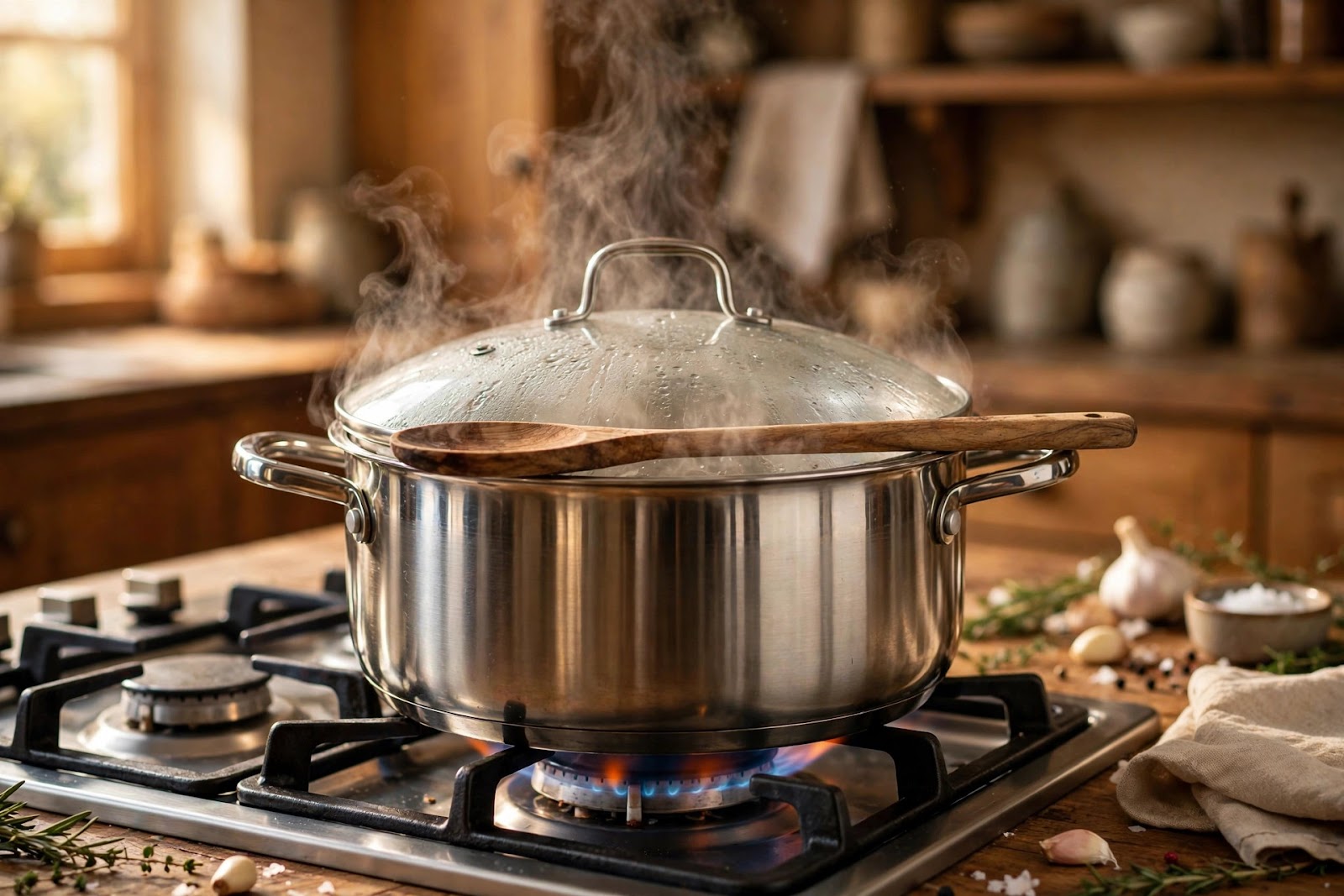
The fix is annoyingly simple: when something's about to boil, crack the lid slightly instead of sealing it. A wooden spoon across the top of the pot works even better — it breaks the surface tension of the foam and stops most boil-overs cold. Old kitchen trick, actually works, I have no idea why I wasn't doing it already.
The other adjustment: turn the heat DOWN earlier. With the lid on, things reach temperature faster, so you can back off the burner sooner than your instincts say. My instinct was calibrated to lid-off cooking, where everything takes longer and needs more heat. Relearning the timing took about two weeks, and then it was automatic.
The exceptions I kept
Not everything gets a lid in my kitchen, and I'm not a zealot about it. Frying stays lid-free — trapping steam on fried food makes it soggy, and no amount of gas saving is worth a sad fried egg. Reducing sauces needs an open pot so the liquid can evaporate. Searing meat needs dry heat, not steam.
But here's the thing: boiling, steaming, simmering, reheating, and rice-making make up probably 80% of my actual hob use. The exceptions are the minority. So the rule is really "lid on by default, off for a reason" rather than "lid always."
Reheating leftovers changed too
This was the unexpected bonus. Reheating soup or curry in a saucepan with the lid on takes noticeably less time — I measured about a third less on the clock. It also reheats more evenly, because the trapped steam heats from above while the hob heats from below. My microwave has been gathering dust for a month and I'm not sure I care.
The simmer test I ran properly
Halfway through the month I got nerdy about it. I made the same vegetable soup twice in one week — same recipe, same pot, same ingredients — once with the lid off at medium heat, once with the lid on at low heat. The lid-off batch took 55 minutes to get the vegetables properly tender. The lid-on batch took 40 minutes, and the flavour was better because less liquid had evaporated away, so I didn't need to keep topping it up with water.
That evaporation point matters more than people realise. An open simmer loses water constantly, which means you're adding water, which means the pot has to reheat the new water, which burns more gas. It's a little cycle of waste. The lid breaks the cycle: the steam condenses on the underside and drips back down. You're cooking with the same water, not replacing it.
My friend who cooks a lot told me this is why professional kitchens work the way they do — lids on stocks, lids on braises, lids on everything that's supposed to be wet. I'd always assumed restaurant pots had lids because of splatter. Apparently it's thermodynamics. Who knew.
What about electric and induction?
I cook on gas, but I asked around. My cousin has induction and she says the difference is even more dramatic — induction heats the pot directly, so with a lid on, water boils shockingly fast. Her kettle-style boil of a pasta pot takes about five minutes with a lid. The principle is identical though: whatever your heat source, trapping the heat at the top means less heat escapes, and less escapes means less you have to add.
One induction-specific tip she gave me: glass lids let you see when things are about to boil over, which matters more on induction because the temperature changes hit faster. On gas you get a bit of grace period. On induction, the moment it's boiling, it's BOILING. Keep an eye on it.
The cooler kitchen bonus nobody mentions
Here's a side effect I didn't expect: my kitchen stayed noticeably cooler. An open boiling pot is basically a small radiator and a humidifier running at once — it pumps heat and steam into the room. With lids on, most of that stays in the pot. On a warm evening, cooking dinner with lids on felt like a different season compared to my old lid-off boil-everything approach.
This has a knock-on effect on energy too. In hot weather, that extra kitchen heat either makes you uncomfortable or makes your cooling work harder. I don't have air conditioning, but I do have a fan, and I ran it less on cooking evenings during the experiment month. Small things stack. Nobody puts "lid on pot" in a cooling-tips article, but it genuinely belongs there.
It also meant less condensation on the windows and less grease settling on surfaces, because less steam was escaping carrying fat particles with it. My extractor fan — which I honestly never cleaned often enough — stayed cleaner. Again: small, boring, real.

What I'd tell someone starting this
First: make sure you actually have lids that fit. This sounds obvious, but I had a frying pan with no lid, a saucepan whose lid was warped, and a stockpot whose lid I'd been using as a tray. I bought two universal glass lids for about £12 total — the glass matters, because being able to see inside without lifting the lid saves you from breaking the heat seal every two minutes.
Second: glass lids pay for themselves. Seriously. Every time you lift a metal lid to check the food, you dump the trapped heat and add minutes to the cooking time. A glass lid lets you peek without lifting. It's the difference between the habit working and the habit being constantly undermined by your own curiosity.
Third: don't buy a whole matching cookware set to start this. That's the trap — spending £200 on new pots to save £5 a month on gas. Universal lids on the pots you own are all you need. The cheapest version of this habit costs literally nothing if your pots already have lids.
The residual-heat trick my grandmother never explained
She always turned the heat off a few minutes BEFORE the food was done and let the trapped heat finish the job. "The pot is still hot," she'd say, like I was an idiot for not knowing. With a lid on, residual heat is even more effective, because the steam keeps working after the flame is gone. For potatoes, eggs, and steamed vegetables, I'll now kill the heat with two or three minutes to go and just leave the lid on. It works every time, and it feels like free cooking.
This pairs beautifully with another trick: batch your hob use. If I'm making pasta and also need to steam some greens, I'll time it so both are on the hob at once rather than heating the kitchen twice. The lid habit trained me to think about heat as something to trap and reuse rather than something to just blast and forget.
The honest verdict
A month of lids saved me about £5 and a noticeable amount of cooking time. The food didn't suffer — some of it got better, especially the rice. The only real costs were two boil-overs, three burned batches of rice while I learned the resting trick, and the minor embarrassment of admitting my grandmother was right all along.
Would I recommend it? Yes, with both hands. It's the smallest energy habit I've ever tested, it requires no discipline after the first fortnight, and the side effects — faster meals, cooler kitchen, better rice — are arguably worth more than the gas savings. Some habits earn their keep through sheer convenience. This is one of them.


