It started with a head of romaine lettuce and a knife. I'd just cut the leaves off for a salad, and I was about to flick the stubby root-end into the compost bin when I remembered something I'd seen online: stick it in water and it grows back. I'll be honest — I was about 80% sure it was internet nonsense. The kind of thing that works in a perfectly-lit time-lapse video and nowhere else. I tried it anyway, because the alternative was throwing it away and the experiment cost me literally nothing.
Three weeks later I was cutting leaves off a little lettuce plant growing in a jam jar on my windowsill. Was it a miracle? No. Was it a real, repeatable thing anyone can do? Also no — at least, not the way most of those cheerful posts make it sound. Here's the day-by-day truth of my regrow jar experiment, including the parts that went wrong and the honest limits nobody mentions.
Why lettuce is the best starter scrap
Not all kitchen scraps are equal. Before lettuce, I'd tried regrowing green onions (easy, almost annoyingly so) and a celery base (slow, fussy, ultimately sad). Lettuce sits in the sweet spot: it responds fast, the setup is trivial, and the feedback loop is short enough to keep you interested.
The biology is straightforward. Lettuce grows from a basal meristem — the growing point at the base where the leaves attach. When you cut a head of lettuce, that base is still alive. Give it water and light and it does what living things do: it tries to grow. You're not creating a plant from nothing; you're waking up a plant that was interrupted mid-life.
Romaine works best in my experience. Butterhead and leaf lettuces work too. Iceberg is the worst candidate — it's been bred for a tight, dense head with minimal growing vigor, and in my one attempt it just sat there looking pale and offended. If you're buying lettuce specifically for this experiment, grab romaine.
The setup (thirty seconds, no special equipment)
Cut the bottom 2 inches off the head — the solid root-end where all the leaves were attached. That's your growing piece. Find a shallow container: a jam jar, a ramekin, a saucer with a lip. Anything that holds half an inch of water and won't tip over.
Place the root-end cut-side up in the container. Add water to about half an inch deep — enough to wet the base, not enough to submerge the whole thing. Put it on a windowsill that gets bright indirect light. Direct hot afternoon sun will cook it; a dark corner will starve it. An east-facing window is ideal if you have one.
That's the entire setup. No soil, no fertilizer, no special water. I used plain tap water. Total cost: zero, assuming you were going to buy the lettuce anyway.
The day-by-day timeline (what actually happened)
Day 1: Nothing, obviously. The cut end looked pale and a little pathetic. I changed nothing and resisted the urge to poke it.
Day 2: The cut surface had dried slightly and formed a thin callus — this is good, it means the plant is sealing the wound. I changed the water (more on water hygiene below).
Day 3: The first sign of life. Tiny pale-green nubs pushing up from the center of the cut. I actually gasped a little. There's something disproportionately exciting about the first green.
Days 4–6: The nubs became recognizable leaves, still pale yellow-green from growing without much chlorophyll yet. Growth was fast — visibly taller each morning. This is the phase where the experiment feels like magic.
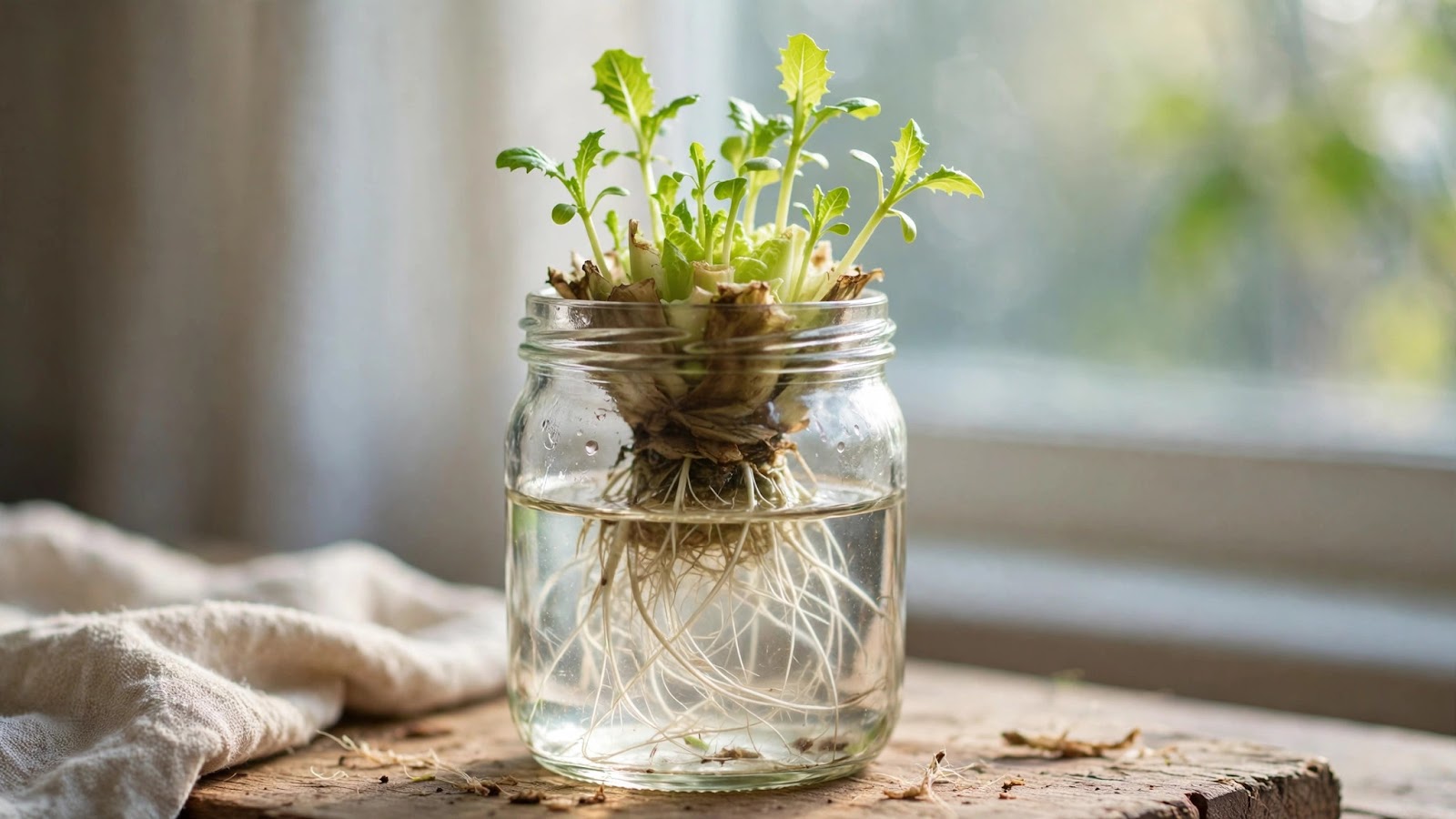
Days 7–10: Real leaves now, green and spreading outward. The plant was about 2 inches tall with a little rosette forming. I started harvesting here — snipping the outer leaves with scissors for sandwiches, leaving the center to keep growing. Cut-and-come-again, same principle as a garden.
Days 11–16: Continued steady growth. The leaves were smaller and thinner than store-bought romaine — more delicate, less crisp — but they tasted like lettuce, fresh and slightly sweet. I got maybe three modest harvests of outer leaves in this window, enough for a few sandwiches and one small salad.
Day 17: Growth visibly slowed. The center started elongating upward instead of making broad leaves.
Days 18–21: Bolting. The plant sent up a central stalk and the leaves turned bitter — classic lettuce bolting, the plant switching from leaf production to flowering. The leaves were still edible but noticeably bitter, the way end-of-season garden lettuce gets. I composted the plant on day 21.
Total harvest over three weeks: roughly two cups of loose leaves. Not nothing. But let's be honest about what that means.
The honest math (manage expectations)
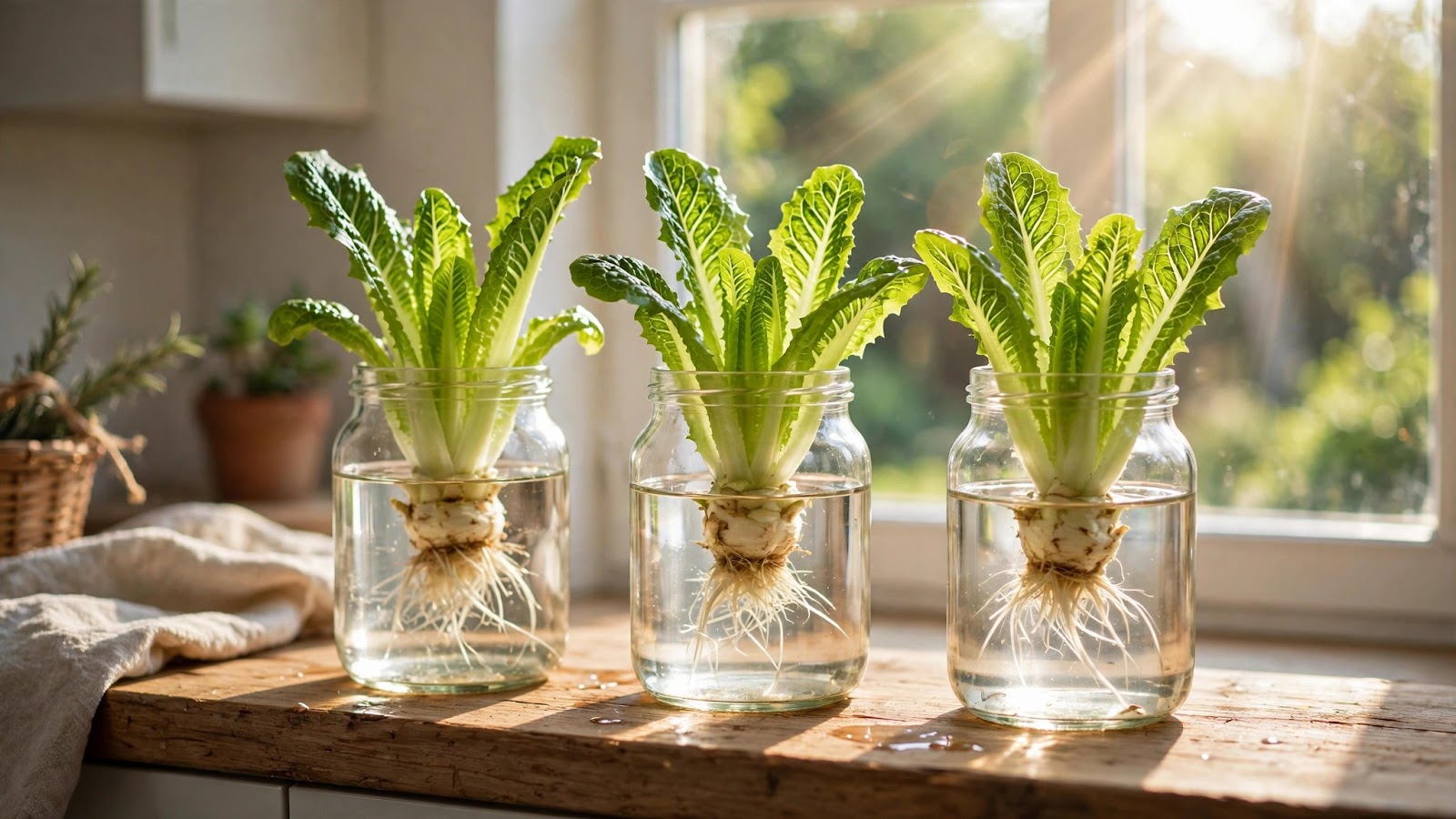
Here's where I part ways with the cheerful internet posts. That jar did not "regrow a whole head of lettuce." It produced, over three weeks, maybe $1.50 worth of salad greens — and that assumes you value your windowsill labor at zero and ignore the daily water changes. You will not feed yourself from regrow jars. You will not meaningfully reduce your grocery bill.
What it IS: a genuinely fun experiment, a nice source of fresh garnish leaves, a great project with kids, and a small daily reminder that food comes from living things. The value is in the experience, not the economics. Anyone who tells you they're saving real money regrowing lettuce in jars is either exaggerating or has fifty jars.
There's a second harvest limit too. Once a lettuce base bolts — sends up that flower stalk — it's done. You can't coax it back. Some people try transplanting to soil at day 10 to extend the run, and it does buy you a bit more time (soil gives nutrients water can't), but the bolting clock is ticking regardless. Indoor regrown lettuce bolts fast because windowsill conditions stress the plant.
Water hygiene: the thing that kills most jars
My first attempt at this — the one before the successful run — failed on day 5. The base turned brown and slimy and smelled faintly of rot. The cause: I hadn't changed the water since day 1. Standing water goes stagnant, bacteria move in, and the cut surface rots before it can grow.
The fix is simple: change the water every day or two. I kept a rhythm of changing it every morning while the coffee brewed. Rinse the container, fresh water, done. If the base starts looking slimy despite fresh water, rinse the base itself under the tap gently. A little browning on the very bottom is fine; mushy brown spreading upward is rot, and that jar is done.
One more hygiene note: don't let the water level creep up. Half an inch, base sitting in it, leaves above it. Submerging the whole root-end accelerates rot. I learned this the celery-failure way.
Light, temperature, and the bolting problem
Lettuce bolts in heat. That's the single biggest limit on this experiment, and it's why my jar ran out of steam at three weeks. Ideal lettuce growing temperature is roughly 60–70°F (15–21°C). A sunny windowsill in summer can easily hit 80°F+ in the jar, and heat-stressed lettuce bolts fast.
If you're trying this in summer, pick the coolest bright spot you have — not the south-facing window that bakes all afternoon. In cooler months, a sunny sill is fine. My successful run was in spring, and I'm convinced the mild temperatures bought me an extra week.
Light matters for leaf quality. Too little light gives you pale, leggy, floppy leaves — technically alive, culinarily depressing. Bright indirect light or a few hours of gentle morning sun is the target. If your only window is north-facing and dim, the experiment will still work, just with sadder leaves. (Honest assessment: still worth doing once for the experience.)
Soil vs. water: is transplanting worth it?
Around day 10, I transplanted a second lettuce base into a small pot of potting soil as a comparison. The soil plant grew sturdier leaves — thicker, darker green, more like real lettuce — because soil provides nitrogen and minerals that plain water lacks. It also bolted about five days later than the water jar, probably because the pot buffered temperature swings.
So soil is better, measurably. But it also turns a zero-effort windowsill curiosity into a small gardening project — you need a pot, soil, drainage, and a saucer. If you already have potting soil around, do the transplant. If you don't, the water jar alone is still worth the experiment. Don't buy a bag of soil just for this unless you're planning a bigger windowsill garden anyway.
What else actually regrows (and what doesn't)
Since the lettuce worked, I got ambitious. Here's my honest scorecard after a season of scrap experiments:
Green onions: nearly foolproof. Put the white root-ends in water and they regrow green tops within days. I've kept one jar going for two months, snipping tops as needed. The regrowth gets thinner over time, but it's the highest-success scrap there is.
Celery: technically works, practically disappointing. The new growth is thin, pale, and strongly flavored — fine for stock, weird in a salad. I won't do it again.
Bok choy: similar to lettuce, moderate success. The regrown leaves are small but tasty. Worth one try.
Carrot tops: they grow pretty green fronds, which look lovely, but they never regrow the carrot. The greens are edible (peppery, good in pesto) but this one surprises people — no, you don't get a new carrot.
Garlic cloves: plant a sprouting clove in soil and you get garlic greens, which are delicious. In water alone they're weak. This one wants soil.
Potato eyes: cut a chunk with eyes, plant in soil, get potato plants. This is actual gardening, not a jar trick, and it genuinely works — but it's a months-long commitment, not a windowsill curiosity.
The kid factor (the real reason to do this)
I have to mention this because it's the best part. My niece visited during the lettuce experiment — she's seven — and the jar absolutely captivated her. She checked it every morning, measured it against her finger, and announced each new leaf like a sports commentator. She now insists on saving every romaine base at her house.
If you have kids in your life, this is a top-tier rainy-weekend project. It teaches where food comes from, it rewards daily attention, and it works fast enough for a child's patience window. The science is real and visible: a living thing responding to water and light. No app, no screen, no batteries. Just a jar and a week.
Mistakes I made so you don't have to
Mistake one: starting with iceberg. Picked the wrong variety, got nothing, assumed the whole concept was fake for a month. Variety matters.
Mistake two: not changing the water. Lost my first romaine to rot on day five. Daily water changes are non-negotiable.
Mistake three: too much water. Submerged the base "to be safe" on my celery attempt. The safe move was the killing move — rot loves submersion.
Mistake four: harvesting too aggressively. On the successful run I got excited around day 8 and cut too many leaves at once, stalling growth for three days. Take the outer leaves, leave the center alone, and never take more than a third at once.
Mistake five: expecting a full head. The internet oversells this. Adjust expectations to "fun garnish supply" and you'll be delighted instead of disappointed.
Troubleshooting: when your jar misbehaves
A few problems come up often enough to address directly. If nothing has sprouted by day 5, the base was probably too old or too dried out — lettuce bases lose viability fast, so start with the freshest head you can and set up the jar the same day you cut it. A base that's been sitting in the fridge for a week rarely wakes up.
If leaves are growing but they're brown at the edges, that's usually a water-quality or temperature issue. Try switching to filtered water for a few days and move the jar somewhere a few degrees cooler. Brown edges on a windowsill in full summer sun almost always mean heat stress, not disease.
If the whole thing smells off, trust your nose and compost it. A healthy regrow jar smells like nothing — maybe faintly green, like a salad. Any sour or rotten smell means bacterial rot has won, and no amount of water-changing will bring that base back. Start fresh; the next head of lettuce is coming through your kitchen soon enough anyway.
One last troubleshooting note: fruit flies love these jars in warm weather. A saucer of apple cider vinegar with a drop of dish soap nearby handles them. Don't skip the water changes — stagnant water is what attracts them in the first place.
Would I do it again?
Yes — and I have, several times since. Not because it saves money (it doesn't, meaningfully) and not because it's the most efficient way to get lettuce (a $2 seed packet in a pot beats it easily). I do it because there's something quietly satisfying about coaxing life out of what was headed for the bin. It changed how I see kitchen scraps — not as waste, but as paused potential.
Start with romaine, change the water daily, keep it cool and bright, and harvest the outer leaves lightly. You'll get three weeks of small fresh harvests and one genuinely delightful windowsill. For zero dollars and thirty seconds of setup, that's a pretty good deal.


