I did not set out to become a person who mends clothes. I set out to avoid spending money in a month when everything else already felt expensive. My grey wool sweater had a hole at the elbow, my favourite jeans had a pocket coming loose, and a work shirt was missing a button. Normally I would have sighed, folded them into a bag for the charity shop, and bought replacements without thinking much about it. Instead, I made a small rule for myself: for one month, nothing gets replaced until I have tried to fix it first.
The sweater was the test case. It was not fancy. I had bought it three winters ago, it fit exactly right, and the cuffs had gone soft in that comfortable way that only comes from wearing something a lot. The hole at the elbow was about the size of a coin. I sat down one Sunday evening with a needle, a spool of grey thread that did not quite match, and a YouTube video paused every ten seconds while I copied the hand movements. My first stitches were uneven and too tight, and the fabric puckered. I unpicked them, loosened up, and tried again. The second attempt looked like actual mending. It was not invisible, and I stopped caring about that about halfway through.
What I keep in my mending kit now
My kit lives in a biscuit tin, which feels right. Inside: a few needles, black, white, grey, and navy thread, a small pair of scissors, spare buttons I have saved from old shirts, a handful of safety pins, and a scrap bag of fabric pieces cut from clothes that were truly finished. That scrap bag has saved me more than once. A square of old cotton shirt became the patch on my jeans pocket. A bit of leftover denim backed the worn inner pocket of my own jacket, where my keys had rubbed the lining thin.
I also learned to keep a needle already threaded in the tin. It sounds lazy, but it is the difference between fixing a loose button the night I notice it and leaving it for three weeks until the button falls off in the washing machine. Small friction is the real enemy of mending. If the kit is buried in a cupboard, the torn shirt stays torn.
The repairs that are actually worth doing
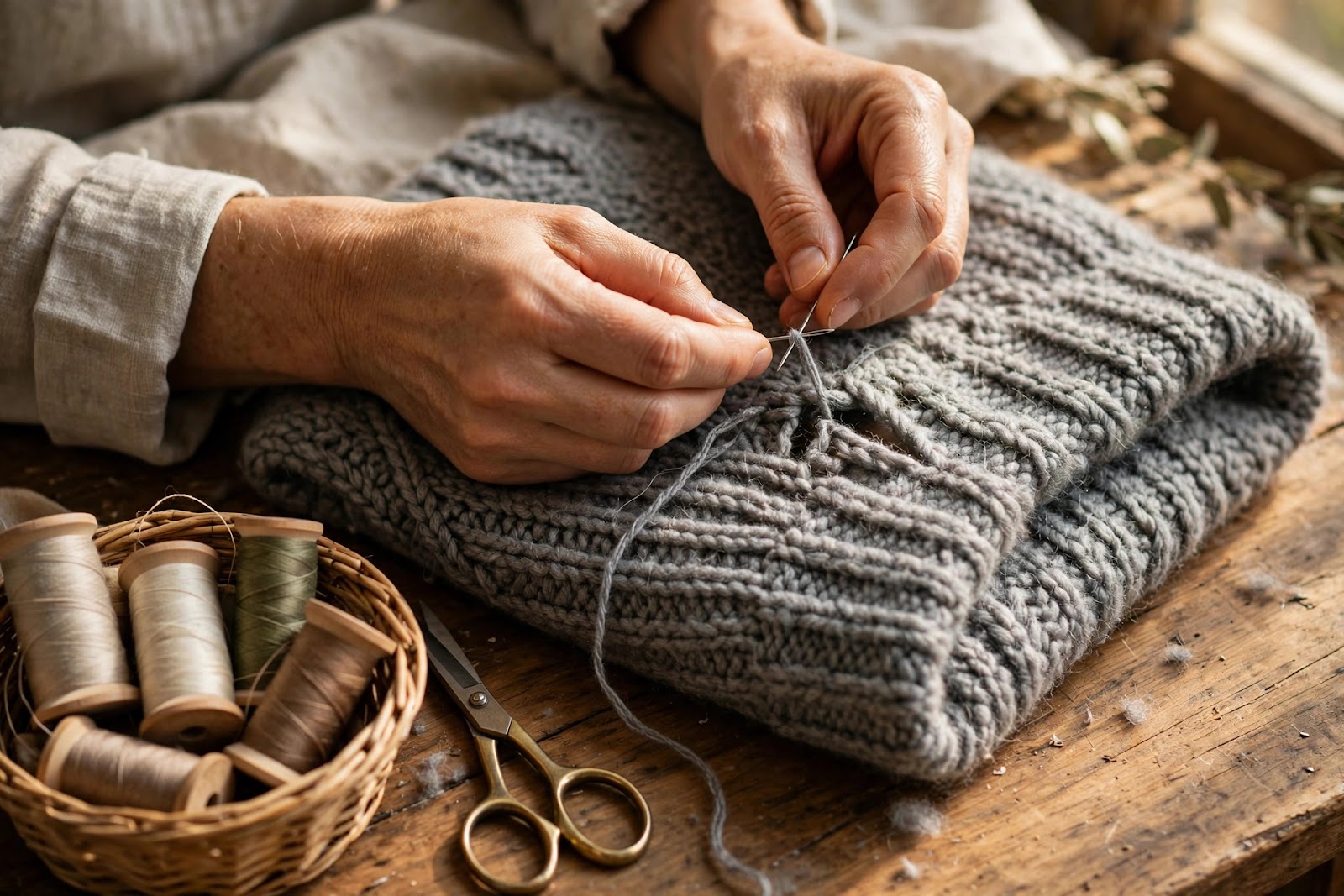
After a month of this, I have a clear sense of which repairs pay off and which ones fight you. Loose buttons and fallen hems are the easiest wins in the whole business. Ten minutes, almost no skill, and the garment looks new again. Split seams are next: a seam that has come apart along its stitching line is just asking to be sewn back, and it is usually stronger the second time because you can catch a little more fabric.
Small holes are worth it too, especially in knitwear and jeans. A coin-sized hole in a sweater can be darned or patched in under half an hour once you have done it once. A worn pocket corner, a frayed cuff edge, a small tear at a stress point — all of these are quick fixes on clothes you already like wearing. The trick is catching them early. A hole doubles in size fast if you keep wearing the garment and washing it, and a small job turns into a reconstruction project.
Visible mending changed how I felt about the whole thing. Instead of trying to hide the repair, I started making it part of the garment. A contrasting patch on the elbow of my jeans jacket, stitched with a simple running stitch in cream thread, looks deliberate. It looks like a choice. My sweater's elbow now has a neat grey patch with slightly visible stitching, and I like it more than I liked the plain sweater. Nobody has ever pointed at it and laughed. Two friends have asked how I did it.
What is not worth saving
Not everything survived the month, and that is part of the lesson. A pair of leggings with elastic that had completely given up was not a repair, it was a rebuild, and new elastic plus an hour of unpicking was more effort than the leggings deserved. A shirt with fabric worn paper-thin across the shoulders would have torn again next to any patch I put on it. And a cheap jacket with a broken zip was technically fixable, but the replacement zip cost nearly as much as I had paid for the jacket, and fitting it meant taking half the lining apart. I let those three go without guilt.
The rule I landed on is simple: if the fabric around the damage is still strong, fix it. If the fabric itself is giving up everywhere, let it go. A mend needs something solid to hold onto. Sewing a patch onto cloth that tears when you pull it is like patching a tyre that has rotted through — you are just moving the hole along a bit.
What the month actually cost me

Here is the honest tally. My mending tin cost me almost nothing to assemble because most of it came from a drawer I already had: needles, thread, and buttons I had been hoarding for years. The only things I bought were a packet of iron-on patches for the jeans jacket and one spool of denim-coloured thread. Together those came to less than the price of a single new sweater, and I fixed five garments with them: the sweater, the jeans, the work shirt, the jacket pocket, and a pair of trousers with a fallen hem.
Buying replacements for those five would have cost me several times what I spent on supplies, and that is before counting the time I would have spent shopping, trying things on, and washing new clothes before they felt right. The new sweater would not have been my sweater. It would have been a stranger that fit almost right. Keeping the old one meant keeping something already broken in, already comfortable, already mine.
There is a slower benefit too, one I did not expect. When you mend a garment, you learn how it is made. I now notice stitching quality when I buy clothes. I check seams and button attachment in the shop instead of just holding something up and guessing. I buy fewer things, and the things I buy last longer, because I am choosing them with a repairer's eye. That shift alone probably saves me more over a year than any single fix.
One thing I wish someone had told me at the start: your first few repairs will look rough, and that is fine. My first darn puckered, my first patch was crooked, and I nearly gave up on the sweater that evening. The fifth repair looked decent and the tenth looked good. Mending is a hand skill, and hand skills improve with repetition the same way cooking does. Nobody expects their first omelette to look like a restaurant plate, and nobody should expect their first patch to look like a tailor did it. The garment does not care. It just needs to hold together, and it will, even if the stitches wobble a bit.
What survived, one month later
A month after my rule ended, the sweater is still in weekly rotation, patch and all. The jeans pocket holds. The work shirt has all its buttons. The jeans jacket with the cream-stitched patch is the thing I reach for on cool evenings. The trousers with the re-sewn hem look untouched. Three garments I would have thrown away are still working hard, and I am still not a person who mends clothes, exactly. I am just a person who fixes the easy things first and only shops when there is genuinely nothing left to save.
If you want to try it, start with one garment you actually like and one small repair: a button, a hem, a split seam. Thread the needle tonight, while the idea is fresh. Your future self, standing in front of a wardrobe full of clothes that fit and a wallet that is a little less empty, will be glad you did.


