I own approximately forty t-shirts and wear about twelve of them. The rest live in a drawer of good intentions — the free conference tee that's two sizes too big, the band shirt with a hole under the arm, the "funny" gift shirt that was never funny. For years they sat there, taking up space, while I bought rolls of paper towels to wipe up spills. Read that sentence again, because the absurdity of it took me an embarrassingly long time to notice.
One Saturday I finally did the obvious thing. I pulled out the worst offenders, got my fabric scissors, and cut them into cleaning rags. Thirty minutes of cutting, one drawer reorganized, and I stopped buying paper towels for most household jobs within a month. That was two years ago. The drawer has never been empty since — because t-shirts, it turns out, keep wearing out at exactly the rate I use rags up.
This is the simplest sustainable swap I know. No special equipment, no learning curve, no money. Just scissors, old shirts, and the willingness to admit that the 5K fun-run tee from 2019 is never becoming a fashion statement.
Why t-shirt rags beat paper towels at almost everything
Let me make the case, because I know some of you are thinking "but paper towels are so convenient." They are. That's their entire business model. But here's what I learned after switching:
A cotton t-shirt rag absorbs more than a paper towel — dramatically more. One rag handles a spill that would take four or five paper towel sheets. It doesn't disintegrate when wet, which means you're not fishing little white bits out of the spill you just cleaned. It wrings out and keeps going. And when it's dirty, you toss it in the laundry instead of the trash, which means one rag does the work of hundreds of paper towel sheets over its life.
The money math is boring in the best way. I was spending roughly $12 a month on paper towels — a big pack every few weeks, because I used them for everything: spills, dusting, glass, the dog's muddy paws. That's $144 a year, gone into the trash literally. Since switching, I buy one pack of paper towels every three or four months, only for the jobs rags genuinely can't do (more on that below). My paper towel spending dropped to maybe $35 a year. The rags cost me nothing — they were shirts I already owned and had already written off.
The waste math is even better. Paper towels can't be recycled — the fibers are too short and they're usually contaminated with whatever you cleaned. Every sheet goes to landfill. A year's worth of my old paper towel habit was something like 15 pounds of trash. The t-shirt rags? They were already manufactured, already worn, and destined for the donation bin at best. Cutting them up gave them a second career instead of a one-way trip.
The first time I did this, I did it wrong
Here's my promised anecdote, and it's a good one. The first time I cut up t-shirts, I made two mistakes that seem obvious in hindsight and were completely invisible to me at the time.
Mistake one: I cut them too small. I figured smaller rags meant more rags, so I cut everything into little six-inch squares. Those tiny squares were useless — too small to hold onto while wiping, constantly slipping out of my hand, and they vanished into the washing machine's rubber seal like they were being eaten. I fished three of them out of the drain filter the first month.
Mistake two: I kept the seams. I cut around the side seams and left them on, thinking they added structure. They don't. They add scratchy ridges that leave streaks on glass and mirrors, and on the first mirror I cleaned, I left a perfect seam-shaped smear right at eye level. My partner thought it was modern art.
The correct method, learned the hard way: cut shirts into pieces roughly 12 by 12 inches — big enough to fold over your hand. Cut OFF all seams, hems, collars, and printed areas (the plasticky printed graphics don't absorb well and can smear ink when wet). What you want is the plain jersey fabric from the front, back, and sleeves. Takes about three minutes per shirt once you get the rhythm. Stack them, fold them in half, and put them in the drawer. Done.
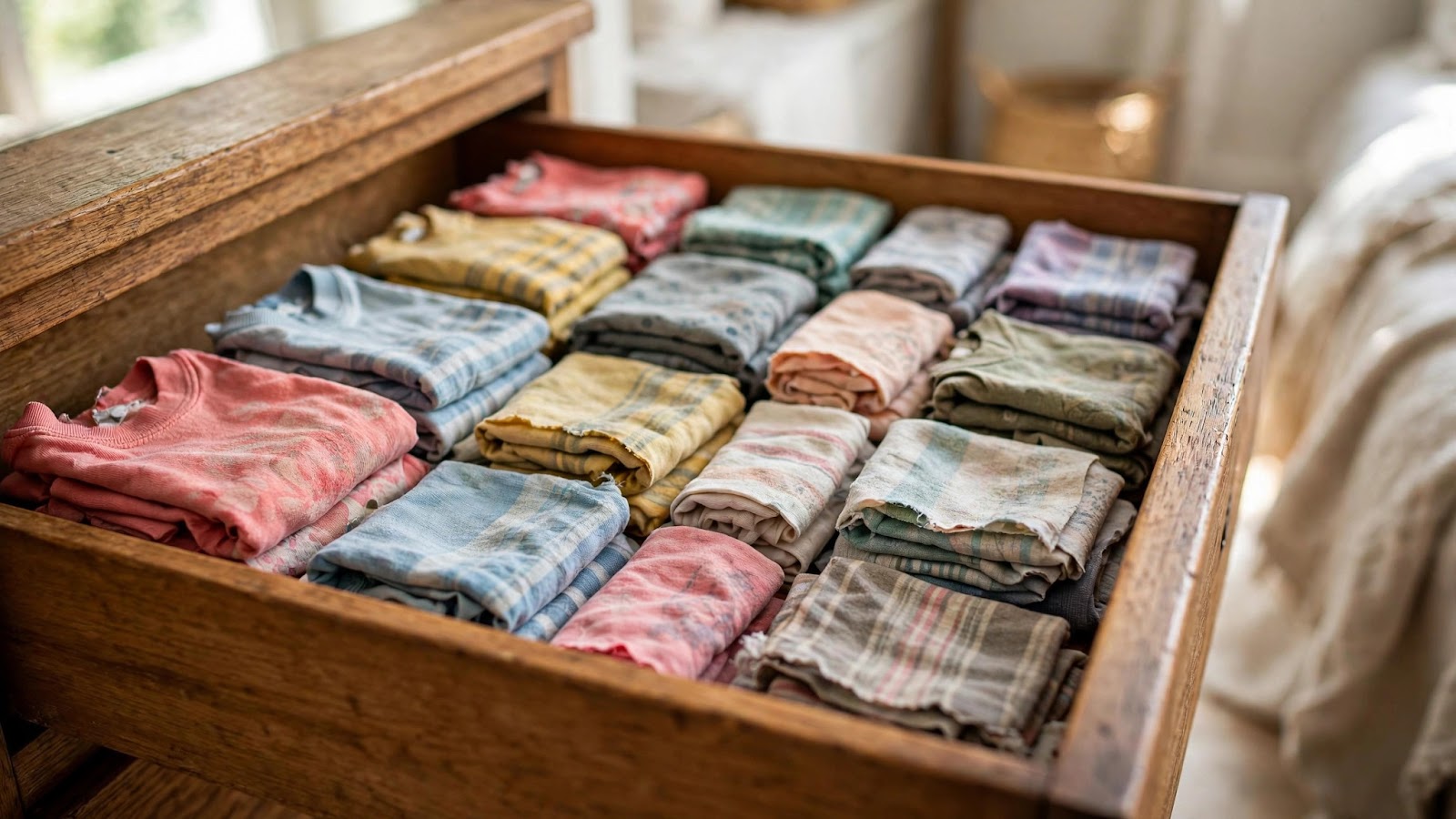
Setting up the drawer (and the system that keeps it working)
The drawer is the whole secret. Not the rags — the drawer. Before I had a dedicated spot, my rags lived in a crumpled pile under the sink, damp and sad, and I kept reaching for paper towels anyway because the rags felt gross. The system matters more than the material.
Here's my setup now, refined over two years. One kitchen drawer — the one nearest the sink — holds clean folded rags, maybe fifteen of them. Under the sink sits a small lidded bin (an old ice cream tub, honestly) for dirty rags. Dirty goes in the bin, and when the bin is full — about once a week — the whole lot goes in the wash with the towels. Clean ones get folded and go back in the drawer. That's it. The loop sustains itself.
A few things that make the system actually work instead of theoretically work. First, keep a few rags in other spots too: two in the bathroom for mirrors and counters, three in the garage or utility area for the truly grimy jobs. Second, designate the ugly ones. Every batch produces a few rags that are stained or thin — those become the "gross job" rags for things like wiping the grill or cleaning the trash can, and they live separately so you never grab a nice one for a disgusting task by mistake. Third, wash them hot with your towels, no fabric softener — softener coats the fibers and kills absorbency, which defeats the entire purpose.
How long does a rag last? In my experience, a good t-shirt rag survives fifty or more wash cycles before it gets thin enough to retire. And retirement isn't the trash — the truly worn-out ones become the gross-job rags, and the gross-job rags eventually become... well, eventually they do go in the trash, but only after a long second life. Nothing about this process is precious. It's rags.
What t-shirts to sacrifice and what to spare
Not every old shirt should become a rag, and I developed opinions about this. The best rag candidates: 100% cotton shirts that are stained, stretched, holey, or just deeply unfashionable. The worse the shirt's prospects as clothing, the better its prospects as a rag. Thin, soft, well-worn cotton is actually the ideal rag material — it's more absorbent than new fabric because years of washing have opened up the fibers.
What to spare: anything with sentimental value (obviously), anything in good enough shape to donate (a wearable shirt helps someone more as a shirt than as twelve rags), and synthetic athletic shirts. The polyester workout shirts make terrible rags — they push water around instead of absorbing it, they hold onto smells like a grudge, and microfiber shedding in the wash is its own environmental question. Cotton and cotton blends only for the rag drawer.
Where do the shirts come over time? That's the beautiful part — the drawer never empties because shirts keep aging out of my wardrobe. Every spring closet cleanout produces two or three candidates. My partner's drawer produces a steady supply too, though I've learned to ask before cutting. (I did not ask once. The shirt was hideous and he never wore it, but I still heard about it for a month. Ask first.)
If you don't have enough old shirts to start — say you just did a big donation purge — ask around. Everyone knows someone with a drawer of unworn tees. I've gotten bags of them from friends who were thrilled someone wanted their ancient promotional shirts. Thrift stores sell t-shirts for a dollar or two if you want to jump-start the supply, though at that point you're buying rags, which slightly misses the point.
The jobs rags do better, and the few they don't
Two years in, here's my honest ranking. Rags win outright at: kitchen spills and counter wiping, dusting (slightly damp rag beats any disposable duster I've tried), cleaning glass and mirrors (with the seam-free ones — learned that lesson), wiping the dog's paws, cleaning the bathroom sink and counters, and polishing — a dry cotton rag buffs faucets and stainless steel beautifully.
Paper towels still win at: anything involving raw meat or serious food-safety situations (I don't mess around with cross-contamination — paper towel, then trash), cleaning up broken glass (a damp paper towel picks up tiny shards safely and goes straight in the bin; never put glass shards in your rag bin unless you enjoy surprises in the laundry), and pet messes of the truly biological variety. Some jobs just want a disposable tool, and that's fine.
The ratio in my house settled at roughly 90/10 — rags for ninety percent of cleaning, paper towels for the ten percent where disposability is genuinely the right call. I keep one roll under the sink for those jobs, and it lasts months now. Before, a roll lasted about a week. That shift alone tells you how much of my paper towel use was pure habit rather than necessity.

The laundry question everyone asks
"But don't you have to wash them? Isn't that water and energy?" Yes, and it's a fair question. Here's my answer: the rags go in with loads I was already running. Towels, sheets, the weekly hot wash — the rags just join an existing load. I'm not running extra laundry cycles for rags. The marginal water and energy cost is effectively zero.
The one real laundry consideration is what you've cleaned with them. If a rag has touched anything chemical — bleach, harsh cleaners — rinse it before it goes in the bin, and don't mix chemical-soaked rags with your regular laundry without a rinse. I mostly clean with a spray bottle of diluted dish soap and one of vinegar solution (the classic combo that handles 90% of household cleaning), so my rags are never carrying anything scary. If you use heavy-duty chemicals regularly, keep separate rags for those jobs and wash them separately. Common sense, but worth saying.
Smell management: if a rag starts smelling funky even after washing, it's usually because it sat damp too long. The fix is the bin system — the lidded bin under my sink has never caused odor problems because the rags go through weekly. If one does go sour, a hot wash with a cup of white vinegar resets it. If it's still funky after that, it gets demoted to gross-job duty or retired. Rags are not precious; don't overthink them.
Beyond t-shirts: the whole rag ecosystem
Once you start thinking in rags, you see raw material everywhere. Old cotton towels with frayed edges become heavy-duty rags for big spills — cut off the frayed parts and you've got the most absorbent rag in the house. Worn-out cotton bedsheets become glass-cleaning champions; the flat weave leaves zero lint. Old flannel shirts and pajama pants make soft dusting rags. Even worn-out cotton underwear — look, I'm just going to say it, cut off the elastic and the fabric is fine for gross-job rags. Waste is waste, and a rag is a rag.
I've also started keeping a small "rag bag" for friends. When I do a cutting session, I make more than I need and hand the extras to anyone who mentions buying paper towels. It's become a weird little evangelism — "here, try these for a week." About half the people convert. The other half smile politely and keep buying paper towels, and that's fine. You can't save everyone from the paper towel aisle.
The deeper shift is the mindset. Before the rag drawer, my default for any mess was "grab something disposable." Now my default is "grab something reusable." That reflex has leaked into other areas — I reach for the reusable grocery bags without thinking, I keep a water bottle in my bag, I buy the refillable cleaning concentrates. The rag drawer didn't cause all of that, but it was the first domino. Small systems teach big habits.
Start tonight, seriously
Here's my challenge, and I mean it: tonight, open your t-shirt drawer and pull out three shirts you haven't worn in a year. You know which ones. The stretched-out one, the stained one, the one from an event you barely remember attending. Get scissors, cut off the seams and collars, cut the rest into twelve-inch squares, and put them wherever you keep your paper towels.
Tomorrow, when you wipe the counter, reach for a rag instead of a paper towel. That's the whole experiment. One day, one rag, one counter. If it feels annoying or gross, you've lost nothing — the shirts were headed for the donation bin anyway. But I'm betting it won't feel annoying. I'm betting it'll feel like one of those embarrassingly obvious improvements that makes you wonder why you waited years to do it.
Two years after my first cutting session, my rag drawer is full, my paper towel spending is down 75%, and my t-shirt drawer finally closes properly. The drawer that never empties, fed by the drawer that finally does. There's a symmetry to it that I find deeply satisfying — and a stack of soft cotton rags that handles every spill in my house. Start with three shirts. The scissors are probably in that junk drawer. You know the one.


