My brown leather boots were four years old and falling apart in slow motion. The heel on the right one had worn down to a slant that made me walk like I was perpetually turning a corner. The stitching along the sole had popped loose in two places, flapping like a tiny flag with every step. I'd already mentally spent the money on a replacement — the high-street equivalent was sitting in my online basket at £95 — when I walked past the cobbler's on a rainy Tuesday and, on a complete whim, asked what a repair would cost.
That whim saved me £37 and gave me boots that are, six months later, genuinely better than the new pair would have been. Here's the full receipt breakdown, what the cobbler actually did, and the rule I now use to decide what's worth repairing and what belongs in the bin.
The quote that stopped me mid-scroll
The shop was one of those places that smells of leather and glue the second you open the door — wooden benches, lasts hanging on the wall, a man in his sixties at the workbench who looked up over his glasses. I put the boots on the counter and asked, expecting him to laugh. He turned them over, pressed the sole with his thumb, tugged the loose stitching, and quoted me without hesitation: full resole £38, new heel lifts £12, re-stitch the welt where it had popped £8. Total £58, ready in three days.
I'd been about to spend £95 on new boots that would then need weeks of breaking in. His £58 quote included making my already-broken-in boots wearable again. I put the phone away, left the basket un-bought, and handed over the boots. It remains one of the better financial decisions I've made in a shoe shop — or rather, in a shoe repair shop.
The receipt, line by line
When I collected them three days later, the receipt was handwritten on one of those duplicate pads, and I kept it because the breakdown is the whole story:
Full resole (rubber soles, stitched): £38. This was the big job — the old soles came off entirely and new rubber soles went on, glued and then stitched around the edge. The stitching matters; it's what keeps the sole attached for years rather than months.
Heel lifts (pair): £12. The slanted heel that had been ruining my walk was rebuilt with new lifts, level again. I hadn't realised how much I'd been compensating until I walked home and my stride felt normal for the first time in months.
Welt stitch repair: £8. The two spots where the stitching had popped were re-sewn, and he ran a reinforcing row along the section that was starting to go. Eight pounds to stop a small problem becoming a boot-killing one.
Polish and condition: free. He gave the uppers a proper going-over with cream polish while they were in — not the quick spray-and-buff, an actual conditioning that fed the leather. Thrown in, no charge, the way a good tradesman does when he respects the thing he's working on.
Total: £58. Against £95 for the new equivalent — and honestly the new equivalent wouldn't have been equivalent, because new boots need breaking in and these were already moulded to my feet.
Getting the quote cost me nothing and took five minutes. That's the part I keep emphasising to friends: you don't have to commit, you don't have to leave your shoes, you just ask. The worst answer is a number that's too high, and then you buy the new pair with a clear conscience. The best answer is what I got.
Before handing them over I asked three questions, and I'd recommend the same: will the resole be stitched or just glued (stitched, or walk away), how long will it take, and is there any guarantee on the work (mine gave six months on the stitching). A good cobbler answers all three without blinking.
What he actually did to them
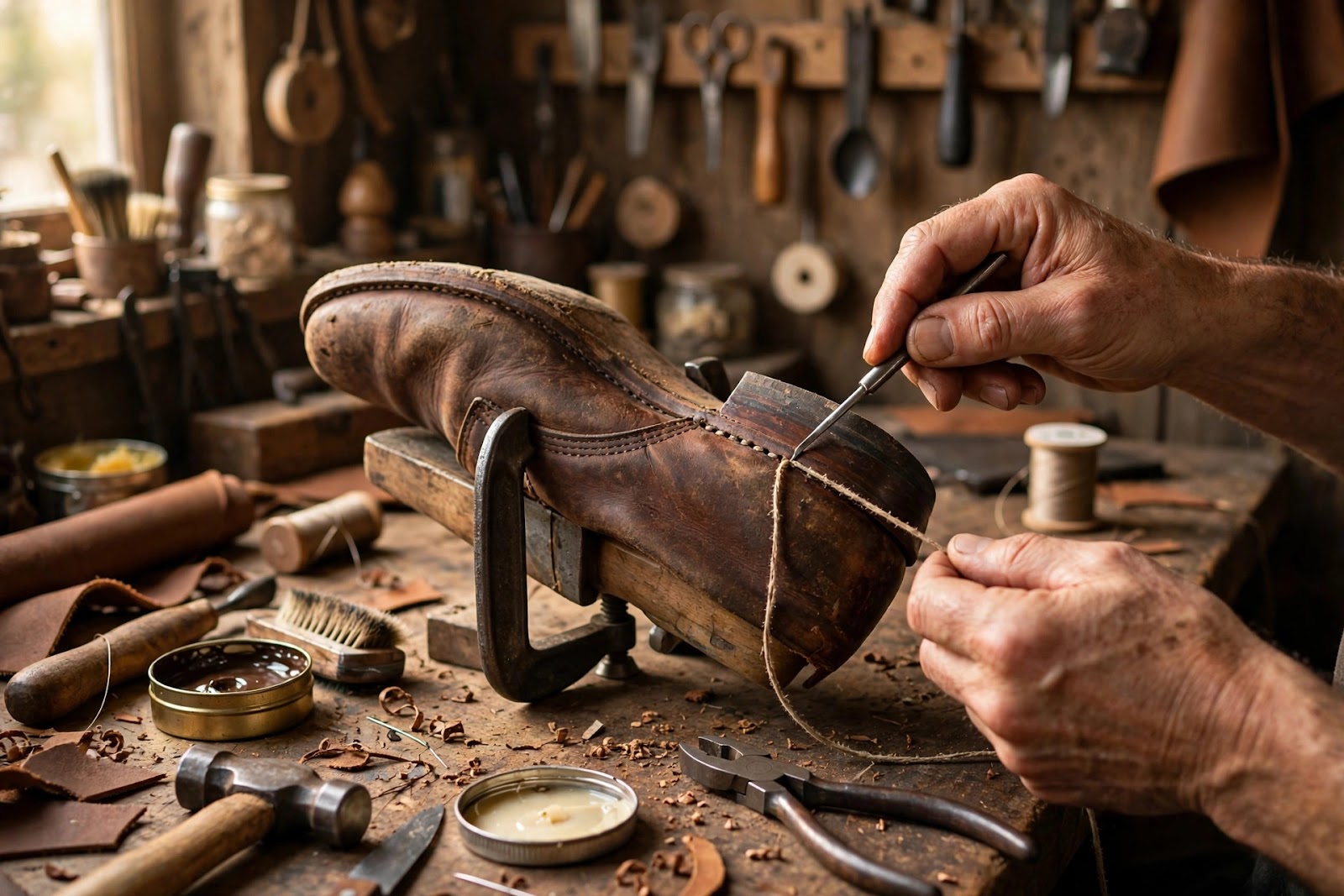
I asked him to talk me through it while I paid, partly out of curiosity and partly because I wanted to know what £58 buys in skilled labour. The old soles were stripped off completely — not patched over, removed. The new rubber soles were cut to fit, glued, and then stitched through the welt, which is the strip of leather running around the base of the upper. That stitching is the difference between a resole that lasts years and one that peels off by spring.
The heel lifts were the fiddly bit. Each heel is built up in layers, and the bottom layer — the bit that hits the pavement — wears fastest. He replaced just that worn layer on both boots and re-levelled them, which is why the walk felt fixed. The welt stitching was re-sewn with waxed thread, and he showed me the original stitching holes to prove he'd followed the same line rather than punching new ones through the leather.
Then the polish. Four-year-old leather dries out, especially around the toe creases, and dry leather cracks — cracked leather is what actually kills boots. The conditioning he did wasn't cosmetic; it was structural maintenance. He told me to feed them with cream polish every couple of months and they'd outlast the new soles. That advice was free too, and it shamed me into a routine I've actually kept:
The 10-minute polish routine
Knock off the dust with a dry brush, work in a thin layer of cream polish with an old T-shirt (a £6 tin lasts me about a year), leave it ten minutes, then buff with a clean brush. Every couple of months, while something's on in the background. It genuinely matters — leather is skin, and ten minutes a few times a year is what stands between these boots and the bin. Weirdly satisfying once you start.
He also gave me the line I've repeated to everyone since: the uppers, he said, had another decade in them. The leather was good quality, the lining intact, no cracks. The only thing dying was the part designed to be replaced. Throwing away the whole boot because the sole wore out, he said, was like scrapping a car because the tyres went bald. I think about that every time I see a skip full of shoes.

Six months later: how they held up
I wear these boots four or five days a week — they're my default for everything except the gym and proper rain. Six months after the repair, the new soles show barely any wear. The heel lifts are still level. The re-stitched welt is holding firm, and the reinforcing row he added is doing its job on the section that was starting to go.
The uppers look better than they did before the repair, thanks to the conditioning and the polish routine I've actually kept up (every couple of months, ten minutes, while watching something — it's become a weirdly pleasant ritual). The toe creases that were starting to look dry have softened. Nothing has cracked. Nothing has flapped.
Compare that with the £35 pair of fast-fashion shoes I bought in 2022 when I was in a hurry: the sole started peeling away from the upper within four months, the "leather" was already flaking at the creases, and no cobbler on earth would have touched them — there was nothing to stitch a new sole to. They went in the bin before the year was out. That's £35 for roughly 120 wears versus £58 of repair on boots that have now done the equivalent of eight years of service. The cheap pair was the expensive pair. It just took me a while to learn the maths.
Run it as cost-per-wear and the flip is even starker. The boots cost £110 four years ago and I'd estimate 800 wears before the repair — about 14p per wear. The £58 repair resets the clock: if the new soles last even three more years of near-daily wear, that's another 700-odd wears at 8p each. The £35 pair that died in four months? Roughly 120 wears at 29p each — the most expensive shoes I've ever owned, measured honestly. I run every shoe purchase through this lens now.
When the maths works — and when it doesn't
I'm not going to pretend every shoe deserves a second life, because the repair has to make financial sense. Here's the rule I use now, cobbler-approved and road-tested.
Repair it when the uppers are good. If the leather (or decent synthetic) is intact, the lining's fine, and the shoe still fits well, the upper is the valuable part — that's what you paid for and what takes months to break in. Soles, heels, stitching, and laces are all consumables. They're designed to wear out and be replaced, and replacing them is almost always cheaper than starting over.
Repair it when the construction allows it. Shoes with stitched soles — Goodyear-welted boots, Blake-stitched shoes, anything where the sole is sewn to the upper — are built to be resoled. That's the whole point of the construction. The cobbler can strip and replace the sole without damaging the shoe. This is worth knowing before you buy, by the way: a £90 pair of stitched shoes you resole twice will outlast three pairs of £40 glued shoes and cost you less per year.
Don't bother when the uppers are shot. Cracked leather, shredded lining, a collapsed heel counter — these are the things a cobbler can't fix economically. If the repair quote creeps past about two-thirds of the replacement cost, walk away. And don't bother repairing very cheap shoes at all: a £20 pair with glued soles costs more to resole than to replace, and the uppers won't survive long enough to justify it.
The honest reason most people don't repair shoes? The gap. Three days without your favourite boots means owning a backup pair, and I was lucky to have one. If you don't, time the repair for a week you're mostly in trainers. The cobbler can fix your soles, not your schedule.
One practical tip for finding a good cobbler: ask whether they stitch soles or just glue them. A proper repair shop does both and will tell you honestly which your shoe needs. Check reviews, look at the work on display, and be slightly wary of anywhere that quotes without looking at the shoe — a good cobbler inspects first, because the repair depends on the construction. Mine spent a full minute with my boots before naming a price, and that minute told me everything about the quality of the next three days' work.
It's also changed how I buy. When I'm looking at new shoes now, I flip them over first: stitched sole or glued? A stitched sole means future resoles are possible — a second and third life built in. Glued soles on anything over £50 go straight back on the shelf. Sales assistants sometimes look at me funny. I don't care.
And one more ten-pound investment: cedar shoe trees. They hold the shape, soak up moisture, and slow the creasing that eventually cracks leather. Mine live in the boots whenever I'm not wearing them. Between the trees, the polish, and a cobbler who stitches, these boots are on a maintenance plan now — which sounds absurd until you realise it's cheaper than the alternative.
The verdict
£58 versus £95, and the £58 option left me with boots that fit perfectly on day one instead of needing a month of blisters. The repair has held for six months of near-daily wear with no sign of giving up. The uppers, per the cobbler, have another decade in them — which means I'm probably looking at one more resole in a few years, another £38-£50, and boots that will have cost me roughly £200 total across a decade-plus of wear.
That's about £20 a year for boots I actually like wearing, versus the churn of buying a £40-£95 pair every couple of years and binning the corpses. The environmental bit barely needs stating: one pair of boots maintained for a decade versus five pairs manufactured, shipped, worn briefly, and landfilled. But honestly? I'd have done it for the money alone.
There's a smaller thing too: the cobbler's shop is still there because people like me walk in. Every repair is a vote for keeping skilled local trades alive, and chatting with a man who's been fixing shoes for forty years beats clicking through a returns portal any day. The boots were the bargain. The conversation was free.
If you're on the fence, start smaller than a full resole. Heel lifts, a re-stitched seam, new laces — most cobblers will do these while you wait for under £15, and it's a good way to test the shop before trusting them with the big job.
Next time a sole wears through or a heel goes slanted, get a quote before you open the shopping app. It takes five minutes, it costs nothing to ask, and there's a decent chance the answer is £58 instead of £95 — with better boots at the end of it.


