The tipping point was a holiday cottage in Cornwall with a shower caddy full of tiny hotel bottles. I counted them while waiting for the water to warm up: eleven. Eleven little plastic bottles, most of them half-used, all destined for a bin the moment we checked out. I'd brought my own full-size shampoo and conditioner, naturally — in two more plastic bottles. Thirteen bottles of plastic for four days by the sea, and I consider myself someone who cares about this stuff.
That was the weekend I decided the bathroom was going solid. No more bottles. Shampoo bar, conditioner bar, and — because my hands crack every winter — a lotion bar too. Sixty days, I'd give it, and if my hair looked like a scarecrow's at the end, I'd admit defeat publicly.
Sixty days are up. Here's the honest verdict, including the fortnight where I genuinely looked like I'd been dragged through a hedge.
Why I Switched (It Wasn't Just the Turtles)
Everyone assumes the motivation is ocean plastic, and yes, that counts — but the real reason was the sheer volume of the stuff passing through my bathroom. I did a count before the switch: in a normal year I got through about six shampoo bottles, four conditioner bottles, three shower gel bottles, and two pump bottles of hand lotion. Fifteen plastic containers a year, and I'm one person with short-ish hair. A family of four must be drowning in the things.
The cost annoyed me too. My usual shampoo was £6.50 a bottle, conditioner £5.50. That's £66 a year on shampoo and conditioner alone, before shower gel. The solid bars I bought — Ethique shampoo bars at £10.50 and a Friendly Soap conditioner bar at £6.95 — looked expensive per unit until I read the small print: one bar lasts roughly 80 washes, equivalent to two or three bottles. Suddenly the maths flipped.
But the thing that actually pushed me over the edge was counter space. Our bathroom shelf was a graveyard of half-empty bottles — the old shampoo I didn't love but wouldn't throw away, the conditioner that didn't suit me, the shower gel someone left behind in 2022. A soap dish with three bars on it looked like a fresh start. Shallow, maybe. Effective, definitely.
Week One: Fine, Actually Suspiciously Fine
I started with an Ethique Professor bar (for normal hair) and their Guardian conditioner bar, plus a Friendly Soap lavender lotion bar for hands. First wash: I rubbed the bar directly on my scalp — four or five strokes — and the lather was instant and thick. Honestly thicker than my old liquid shampoo. I was suspicious. Things that work this well on day one usually have a catch.
The conditioner bar needed a learning curve. You rub it between your palms to warm it, then smooth it down the lengths of your hair. First attempt I used way too much and my hair felt coated. Second attempt I used too little and the ends felt dry. Third attempt was the sweet spot, and I wrote it down like a lab result: eight seconds of rubbing, mid-lengths to ends only, leave for one minute while I do everything else.
Hair dried, looked... normal. Good, even. Slightly more volume than usual. I texted my partner "this might actually work" and she replied "give it a month," which turned out to be annoyingly wise.
Weeks Two and Three: The Waxy Disaster
Here's the part the cheerful zero-waste blogs gloss over. Around day ten, my hair started feeling waxy. Not dirty exactly — more like coated, as if I'd put too much product in and couldn't wash it out. By day fourteen it looked lank by lunchtime. I was running my fingers through it at my desk like a nervous teenager.
I nearly quit. I stood in the shower on day sixteen holding the bar and thinking about the perfectly good bottle of shampoo in the cupboard. The transition period is real, and anyone who tells you otherwise is selling something.
What's actually happening: liquid shampoos use strong detergents (usually sodium laureth sulphate) that strip everything off your scalp, so your scalp overproduces oil to compensate. Solid bars — the good ones — use gentler surfactants like sodium cocoyl isethionate. Your scalp needs time to recalibrate its oil production, and that takes two to four weeks. It's not the bar failing. It's your scalp adjusting to not being assaulted daily.
What got me through: an apple cider vinegar rinse. One tablespoon in a mug of cool water, poured over my hair after conditioning, left for thirty seconds, rinsed. It cut the waxiness immediately. I did it twice a week for the first month and then stopped needing it. If you try this switch, buy the vinegar before you start — you'll thank me on day twelve.
By day twenty-one, the waxiness was gone. Not improved — gone. My hair settled into a texture I can only describe as its actual texture, the one it has when it's not being stripped and re-coated by silicone-laden liquids. It held a style longer. It needed washing every three days instead of every two. That last bit surprised me most.
Which Bars Survived (and Which Didn't)
Not everything made the cut. Here's the honest scorecard after sixty days.
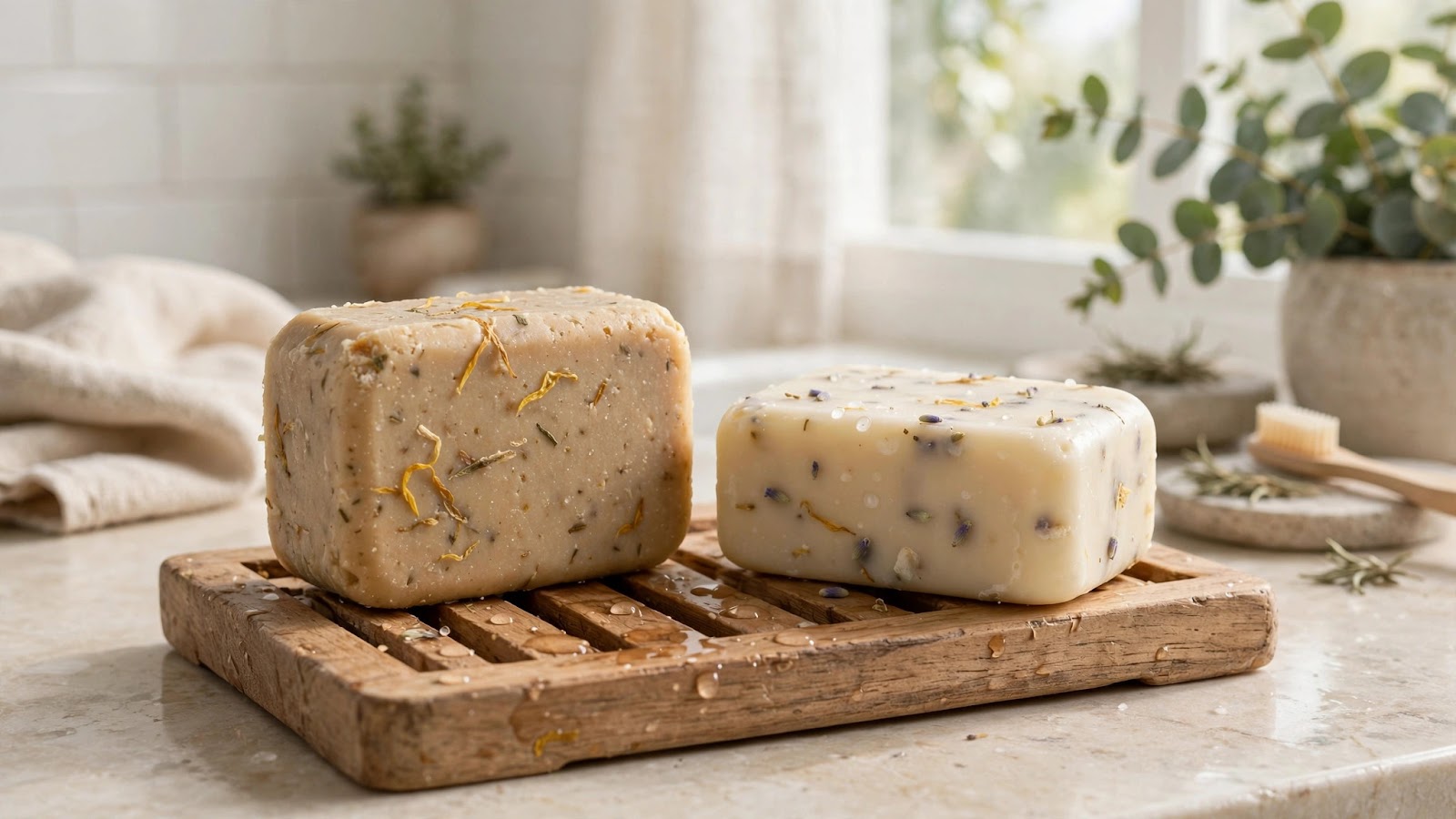
The Ethique Professor shampoo bar: survived, and I've bought a second. At £10.50 for roughly 80 washes, that's 13p a wash versus about 27p per wash for my old bottled stuff. It lives in a bamboo soap dish (£4 from a local shop) on the shower shelf, and the key trick is keeping it out of the direct water stream. Bars that sit in a puddle dissolve into mush within weeks. Mine's on a slatted dish that drains, and after sixty days it's about the size of a large coin — on track for the full 80 washes.
The Friendly Soap conditioner bar: survived. £6.95, and it's barely half gone after two months — conditioner bars last absurdly long because you use so little. My one complaint is that it smells quite strongly of lavender for the first week, then fades to nothing. Fine by me.
The lotion bar: this was the revelation I didn't expect. The Friendly Soap lavender and tea tree lotion bar (£7.50) replaced my pump-bottle hand cream, and it's better. You warm it in your palms and it melts into this rich layer that actually lasts through hand-washing — my old cream needed reapplying three times a day in winter, the bar needs once, morning and night. My cracked winter knuckles healed in about ten days. I now keep one by the kitchen sink too, because washing-up liquid destroys hands and the bar is right there.
What didn't survive: a "2-in-1" shampoo-conditioner bar I bought on impulse at a market stall (£8, no brand I recognised). It left my hair feeling like straw and smelled like a car air freshener. Lesson learned: buy from established makers with ingredient lists you can read. The market-stall gamble cost me a week of bad hair days.
I also tried a solid shower gel bar and gave up after three weeks — not because it was bad, but because I realised I don't need a separate body wash product at all. The shampoo bar's lather works fine on skin. One less thing to buy, store, and finish.
The Plastic Count
Sixty days in, I did the audit. Old routine for sixty days: roughly one shampoo bottle, two-thirds of a conditioner bottle, half a shower gel, a third of a hand cream pump. Call it two and a half plastic containers. New routine: zero. Three bars on a dish, and when they're done, nothing goes in the bin — the Ethique bars come in a cardboard box that goes in recycling, Friendly Soap uses paper wrap.
Projected over a year: fifteen plastic containers avoided. Over five years: seventy-five. It's not going to save the ocean single-handedly, but it's seventy-five fewer things I personally put into the system, and it cost me less money, and my hair looks better. The rare lifestyle change where every metric points the same way.
One honest caveat: the bars aren't zero-impact. They're manufactured, shipped, packaged in card. I'm not claiming moral purity, just a smaller footprint and a tidier shelf. Anyone selling you "zero waste" as an absolute is selling you something.
The Travel Bonus Nobody Mentions
The unexpected win: travelling. I flew to visit family last month with just a carry-on, and the three bars went into a small tin (£3.50, fits all of them with room). No decanting into 100ml bottles. No leaking shampoo exploding inside a zip-lock bag — which happened to me twice in 2023 and ruined a paperback both times. No liquids bag at security. I walked through with my little tin like a smug Victorian apothecary.
Hotel bathrooms stopped being a plastic-counting exercise. I used my bars, left nothing behind, took nothing. It felt — I can't quite describe it — tidy. Like the trip had no loose ends.
The tin does need one rule: open it when you arrive so the bars air-dry. A sealed wet bar in a tin goes soft and gloopy. Learned that on day two of the trip. Open tin, bars on the bathroom shelf, close tin for the journey home.

The Full Cost Comparison
I'm a spreadsheet person, so I ran the numbers properly. Old routine, annual cost: six bottles of shampoo at £6.50 (£39), four conditioners at £5.50 (£22), three shower gels at £4 (£12), two hand creams at £7 (£14). Total: £87 a year. New routine: shampoo bars — one bar lasts about 80 washes, I wash every three days, so that's roughly 120 washes a year, meaning 1.5 bars at £10.50 (£15.75). Conditioner bar: one £6.95 bar lasts me about five months (£16.70 a year). Lotion bars: two a year at £7.50 (£15). Total: about £47.50 a year.
Saving: roughly £40 a year, every year, forever. Plus the shower shelf looks like a boutique hotel. I did not expect the financial argument to be this clear, but there it is: the "expensive" bars are nearly half the price of the "cheap" bottles once you count washes instead of units.
The catch is the upfront spend. Switching cost me £35 in one go (two bars, a lotion bar, the tin, the bamboo dish). If you're on a tight budget, that's real money. My suggestion: switch one product at a time. Finish your current shampoo, then buy the bar. The dish can wait — a folded flannel works as a draining surface in a pinch. I used one for the first fortnight and it was fine, if slightly student-flat aesthetic.
Getting the Rest of the House On Board
My partner watched the whole experiment with folded arms for the first month. "Your hair looks weird," she said on day thirteen, helpfully. By day forty she was using the conditioner bar on her ends "just to try it." By day fifty-five she'd ordered her own shampoo bar — a different one, for colour-treated hair, because she's particular and rightly so.
The lesson: don't evangelise, demonstrate. Nobody adopts a new bathroom routine because of a lecture about microplastics over dinner. They adopt it because your hair looks good and the shelf looks tidy and you mention, casually, that you haven't bought shampoo in two months. The bars sell themselves once the waxy fortnight is over.
One practical note for shared bathrooms: label the bars. A shampoo bar and a conditioner bar look identical when wet, and nothing sours a convert faster than conditioning their scalp with shampoo bar on a Monday morning. I pressed a little "S" and "C" into ours with a toothpick while they were soft. Low-tech, works perfectly.
What I'd Tell a Friend Starting Out
First: expect weeks two and three to be rough, and have the apple cider vinegar ready. Most people quit on day twelve and conclude "bars don't work for my hair." Day twelve is the worst day, not the verdict.
Second: buy one shampoo bar and one conditioner bar to start, from a proper maker — Ethique, Friendly Soap, HiBAR, or your local equivalent. Don't buy the variety pack of six. Find one that suits you first; the rest is a distraction.
Third: the soap dish matters more than the bar. A draining dish — slatted bamboo, or one of those magnetic holders — doubles a bar's life. A bar sitting in water dissolves while you sleep. This is the single biggest factor in whether bars feel "expensive" or "cheap."
Fourth: keep your expectations honest. Bars won't transform your hair into a shampoo advert. They'll give you clean, healthy hair with less plastic and less money, and after the adjustment, less washing. That's the whole deal, and it's a good one.
The surprise hit for me was the lotion bar. I was sceptical — rubbing a solid block on dry legs felt like a gimmick — but by the third evening the penny dropped: no greasy residue on the sheets, and the same bar lasted the full two months. My nightstand went from four bottles to zero, and I stopped dreading the damp towel on the duvet.
Sixty days done. The dish on my shower shelf holds three bars, the shelf holds nothing else, and the cupboard under the sink — once a bottle graveyard — is empty enough that I found a candle I'd forgotten buying. The bathroom feels like someone competent lives here. I'll take competent.


