It started with a glass of water at 2am. I woke up thirsty, filled a glass from the kitchen tap, and got a mouthful that tasted like a swimming pool. Not dramatically — not like I was going to call the water company — but enough chlorine smell and taste that I stood there in the dark thinking, has it always been like this?
The answer was yes. It had always been like this, and I'd just never noticed because I'd spent years grabbing water from the office cooler or buying those giant refillable jugs at the grocery store. Once I noticed it, though, I couldn't un-notice it. Every glass of tap water tasted faintly of a public pool, my tea had a weird sharpness to it, and I started doing the thing where you let the water run for ten seconds first like that's some kind of solution. It isn't.
So I did what most people do: I bought a filter jug. A basic pitcher-style one, the kind you find at every big-box store, around twenty-five dollars, with a filter cartridge that supposedly lasts two months. And then, because I'm the kind of person who can't just enjoy a thing without testing it, I ran a little experiment on it. Two weeks, a notebook, and a genuinely suspicious amount of attention paid to water.
This is what I found.
Why tap water tastes like chlorine in the first place
First, the part that made me feel better about the whole situation: chlorine in tap water is not an accident or a failure. Municipal water treatment plants add chlorine (or a related compound called chloramine) on purpose, because it kills bacteria and keeps water safe as it travels through miles of pipes. It is one of the great boring miracles of public health. The pool taste is a side effect of safety, not a sign of danger.
That said, "safe" and "pleasant" are different things. The taste threshold for chlorine is low — many people can detect it at levels well below what's considered fine to drink. How strong it tastes depends on how far you live from the treatment plant, the season, and the temperature of the water. My house is close to the plant, which is why my 2am glass tasted like the deep end.
Here's something I didn't know until I looked it up: you can remove most of the chlorine taste without any equipment at all. Fill a pitcher and leave it uncovered in the fridge for a few hours, and the chlorine dissipates into the air. It's free, it works, and it's the reason my grandmother's water always tasted fine even though she never owned a filter in her life. I tested this too — a covered glass versus an uncovered pitcher, tasted side by side after four hours. The uncovered one was noticeably better. Free beats twenty-five dollars, at least sometimes.
The filter jug test: how I actually ran it
I'm not a lab. I want to be upfront about that. I didn't send samples anywhere or buy test strips with forty little color squares (though I was tempted — the internet really wants to sell you water test kits). What I did was practical: I bought the jug, followed the instructions exactly, and then compared water in the ways that actually matter to a person drinking it.
The setup: same tap, same time of day (mornings, when the chlorine smell was strongest in my kitchen), three samples. Straight from the tap. From the filter jug, poured immediately. From the filter jug, chilled for two hours. I tasted each one blind — my partner labeled three identical glasses A, B, and C while I looked away — and rated them on chlorine smell, chlorine taste, and overall "would I happily drink a big glass of this."
The first time I ran the test, I messed it up, and the story is worth telling. I forgot to soak the new filter cartridge before installing it. The instructions said to soak it for fifteen minutes — I skimmed past that part because who reads filter instructions — and the first two pitchers tasted faintly of wet cardboard. I nearly wrote the whole jug off as a scam. Then I actually read the manual, soaked a fresh cartridge properly, flushed two full pitchers through it as instructed, and the cardboard taste vanished. Read the instructions. I'm saying this to you because I definitely did not say it to myself in time.
Once I was testing properly, the results were clear enough that my partner and I agreed on them without arguing, which almost never happens. Fresh-filtered water beat tap water every single time. The chlorine smell dropped from "noticeable immediately" to "basically gone." The taste went from swimming-pool-adjacent to neutral. And the chilled filtered water — the jug living in the fridge, poured cold — was the clear winner, the kind of water you drink without thinking about water at all.
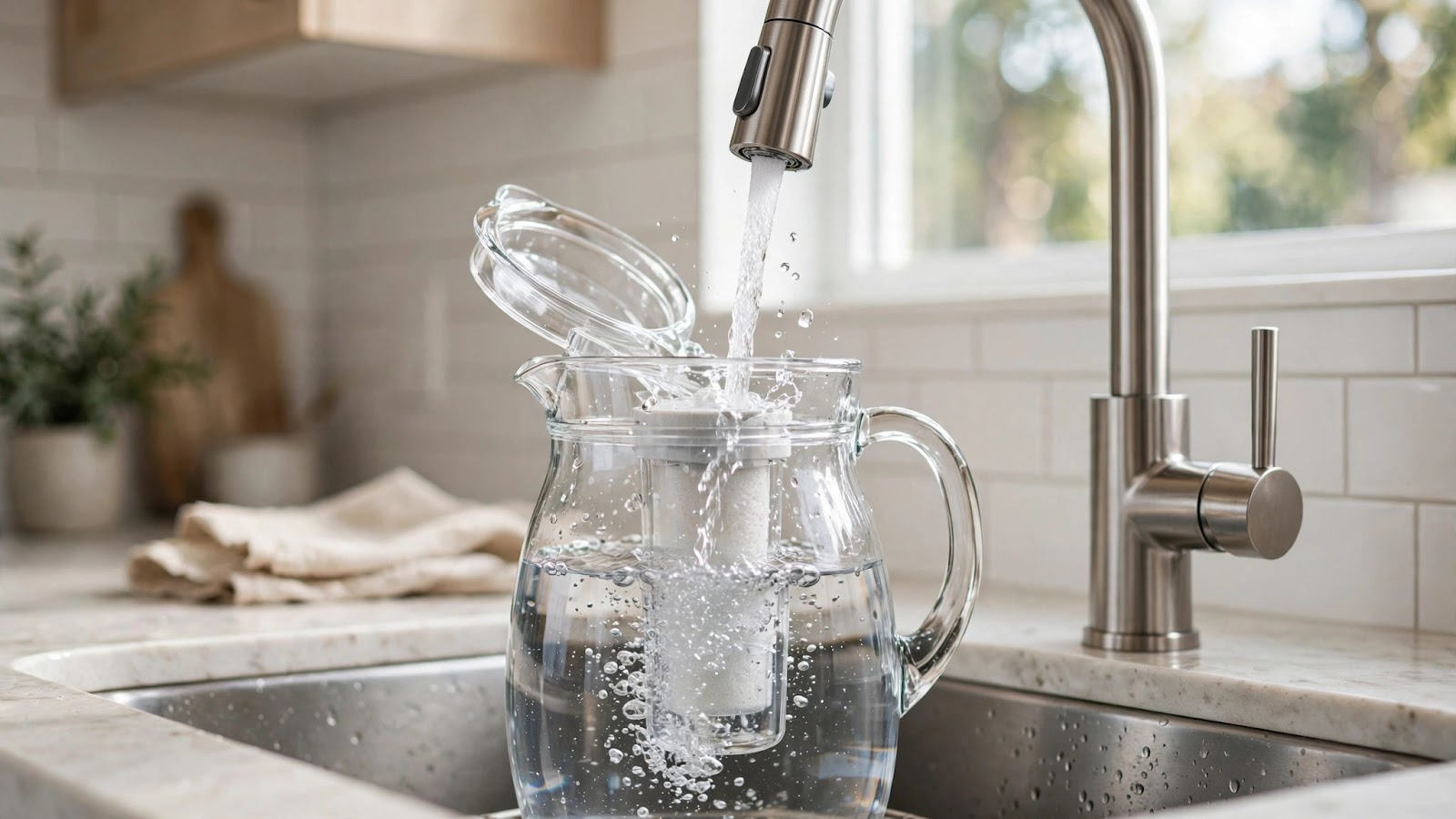
What a filter jug does and doesn't do
Let's talk honestly about what you're buying, because the marketing on these things is a fog of vague wellness language. A standard pitcher filter uses activated carbon, which is very good at grabbing chlorine, some organic compounds, and the stuff that causes off tastes and odors. It makes water taste better. That's the main job, and it does it well.
What it doesn't do: it doesn't remove everything. Standard pitcher filters generally don't remove dissolved minerals, most heavy metals in meaningful amounts, fluoride, or nitrates. If your concern is lead from old pipes, you need a filter specifically certified for lead — not every jug has that certification, and the box will say so clearly if it does. My test was about taste, not safety, and I want to keep those two separate. My tap water was already safe. I just wanted it to not taste like a pool.
The certification thing is worth thirty seconds of your time. In the US, look for NSF/ANSI certification numbers on the packaging — they're the independent verification that the filter actually does what the box claims. It's the difference between a filter that removes chlorine because carbon does that, and a filter whose lead-removal claim has been tested. If the box only says "improves taste" with no certification marks, treat it as a taste product and nothing more.
The real cost: cartridges, the subscription trap, and my spreadsheet
The jug was $25. The cartridges are where they get you. Mine cost about $7 each when bought in a multipack, and each lasts roughly two months for a household of two people drinking normal amounts. That's about $42 a year in cartridges. Fine. Reasonable. But here's the part that annoyed me: the jug came with a little sticker telling me to replace the cartridge every month, and the manual suggested signing up for automatic cartridge deliveries.
I tracked my actual usage instead of trusting the sticker. Two people, cooking and drinking, went through about 40 gallons a month — the cartridge is rated for 40 gallons, so the two-month claim was about right for us. A single person might stretch it to three months; a family of five will burn through one in weeks. The monthly-replacement sticker is just upselling. Track your own use, mark the install date on the cartridge with a permanent marker (takes five seconds and saves you from the "did I change this in March or May?" mystery), and replace based on volume and taste, not the sticker.
Compared to what I was doing before — buying those big refillable jugs at the grocery store for about $7 a fill, roughly twice a month — the filter jug pays for itself in about four months. Compared to bottled water cases, it's not even close; the jug wins by a landslide. Compared to just drinking the tap water as-is, it costs $42 a year for water that tastes dramatically better. That felt worth it to me. Your tap water might taste fine already, in which case skip the whole thing.
One sustainability note, because this is a sustainable living blog and I should say it: the cartridges are plastic and need replacing, which is real waste. Some brands run recycling programs for used cartridges — mine does, though I have to mail them in, which I keep forgetting to do. (They're currently in a bag under my sink, judging me.) A filter jug is greener than buying bottled water by an enormous margin, but it's not zero-waste. If that bothers you, the free uncovered-pitcher-in-the-fridge method handles chlorine with zero ongoing waste.
The tea test, which surprised me
I wasn't expecting the biggest difference to show up in tea. I drink a lot of black tea, and I'd always assumed my slightly harsh, flat-tasting cups were about my brewing technique — too hot, too long, wrong leaves. During the test period, I made two cups side by side: one with tap water, one with filtered. Same tea, same timing, same mug type.
The filtered-water cup was better in a way that made me a little annoyed, because it meant years of mediocre tea had been a water problem all along. The tap-water cup had a sharp edge and a kind of chalky finish. The filtered cup was smoother, rounder, and the actual tea flavor came through instead of fighting with the chlorine. My partner, who claims not to care about such things, picked the filtered one blind and then asked me to stop making the tap-water version.
Coffee people tell me the same thing, and I believe them, though I'm a tea person so I tested what I drink. If your morning cup has been underwhelming and you've been blaming the beans or the leaves, try changing the water first. It's the cheapest variable to fix.

Fridge placement and the habit that makes it stick
The unsexy truth about filter jugs: the jug only works if you use it, and you only use it if it's convenient. The first week, I left mine on the counter next to the sink, and I kept drinking straight from the tap anyway out of pure habit. The jug sat there, full of excellent water, ignored.
What fixed it was putting the jug in the fridge door, front and center, and moving the tap habit out of reach — I stuck a little note on the faucet for a week that just said "jug." Childish? Sure. Effective? Completely. Within ten days, reaching for the jug was automatic. Cold filtered water on demand beat room-temperature tap water with zero willpower required.
This is the part the product reviews never mention: a filter jug is a habit product, not just a water product. The filtration is the easy part. The hard part is the two weeks of remembering. Put it where your hand goes naturally, keep it full (refill it when it's half empty, not when it's bone dry), and give yourself the grace period. If it lives in the back of the fridge behind the leftovers, it's a $25 decoration.
When a jug isn't enough: knowing your actual water
I should say the thing the wellness influencers won't: a filter jug is a taste solution, not a safety solution. If you have real concerns about your water — old lead pipes in your building, a private well, a notice from your water utility, anyone in the house with a compromised immune system — a pitcher filter is not the answer. Get your water tested properly.
Many municipalities publish annual water quality reports, and they're worth reading — dry, but informative. In the US, utilities are required to send them out yearly; most people throw them away unread. Mine showed exactly what I'd expect: safe levels of everything, with chlorine doing its disinfection job. That report is what let me treat this whole project as a taste experiment rather than a health worry, and I'd suggest reading yours before spending a dollar on any filtration.
For renters in old buildings, the calculus is different and I want to acknowledge that. You can't replumb your apartment. A certified lead-reducing pitcher is a reasonable middle step while you figure out the bigger picture — and testing your tap through a proper lab (many local health departments offer low-cost testing) tells you what you're actually dealing with instead of guessing. Don't let a taste blog post talk you out of taking real concerns seriously.
My honest verdict after two weeks of overthinking water
Would I buy the jug again? Yes, without hesitation. My water tastes like water now. My tea is better. The whole thing cost less than a nice dinner out, and the ongoing cost is a few dollars a month. It sits in my fridge door and I refill it while the kettle boils, which has become one of those tiny satisfying routines.
But here's the honest caveat I owe you: if your tap water already tastes fine, you don't need this. I have a friend across town whose water tastes great straight from the tap — different part of the system, farther from the plant, whatever the reason — and when I told her about my whole experiment, she looked at me like I'd joined a cult. She was right. This is a solution to a specific problem: water that tastes of chlorine. If that's not your problem, spend the $25 on something you actually need.
And if chlorine taste IS your problem but you don't want another gadget: try the free method first. Uncovered pitcher, fridge, a few hours. My grandmother's approach, validated by my side-by-side test. If that solves it for you, congratulations — you just saved $25 and a lifetime of cartridge replacements. If you want it colder, faster, and on demand, the jug is waiting. Either way, you get to stop drinking swimming pool water at 2am, and honestly, that's the whole point.


