The smell that started it
The first time I tried composting in my flat, I did it the way most people do: I put a little bin under the sink, threw in vegetable peelings, and waited for nature to take its course. Nature took its course in about four days. The bin smelled like a dustbin in August, a cloud of fruit flies moved in, and my flatmate opened the cupboard, closed it again without a word, and left a window open for the rest of the evening. I emptied the bin into the outside rubbish, scrubbed it with bleach, and told myself composting was a house-with-a-garden thing. It wasn't for flats. It wasn't for me.
That lasted about a year. Then two things happened: the council started charging for extra rubbish bags, and I got properly annoyed about throwing away good vegetable scraps — the carrot tops, the coffee grounds, the banana peels — knowing they were going to sit in a landfill making methane. So I tried again, but this time I did the reading first. And the reading said something I hadn't known: the smell wasn't composting. The smell was composting done wrong.
Eighteen months later, I have a worm bin under my kitchen sink that has never smelled, a freezer bag routine that takes thirty seconds a day, and a tub of black compost on my balcony that my basil plants treat like a five-star hotel. This is the setup that actually works in a tiny apartment, including the mistakes I made getting there.
Why most flat composting smells (and why mine did)
Here's the thing nobody told me the first time: a compost bin smells when it goes anaerobic — when there's too much wet food, not enough air, and not enough dry, carbon-rich material to balance it. My first bin was a sealed plastic tub full of wet peelings and nothing else. It was a swamp, not a compost bin. Of course it stank.
The fix isn't a magic powder or a charcoal filter (though the filters help). The fix is the ratio. Every handful of wet kitchen scraps needs roughly the same volume of dry "browns" — shredded cardboard, torn newspaper, dry leaves, the cardboard tube from a toilet roll. Browns soak up the moisture, let air in, and give the whole thing structure. My first bin had zero browns. My current setup is probably 60% browns by volume, and the difference is night and day.
The second fix is the freezer. This is the trick that changed everything, and it's so simple I felt stupid for not thinking of it: keep a bag or tub in the freezer, and put your scraps in there as you cook. Frozen scraps don't rot, don't smell, and don't attract a single fruit fly. When the bag is full — about once a week for me — you empty it into the compost bin in one go. No daily dripping, no half-rotten onion sitting in a caddy for three days. Thirty seconds a day, one weekly trip to the bin.
The worm bin: my actual setup
After the freezer trick, I needed somewhere for the scraps to actually go. I looked at three options and I'll be honest about all of them, because the right choice depends on your flat.
A bokashi bin ferments scraps in an airtight bucket with a sprinkle of bran. It works, it doesn't smell much, but you still need somewhere to bury the fermented result — and the bucket produces a liquid you have to drain every few days. In a flat with no garden and no balcony soil to bury things in, that was a dead end for me.
An electric countertop composter dries and grinds scraps into a dry crumb in a few hours. It works brilliantly and it genuinely doesn't smell. It also costs £250 to £400, uses electricity every cycle, and the output isn't finished compost — it's dehydrated food that still needs to break down in soil. If you've got the budget and you hate faff, it's a good option. I didn't have the budget.
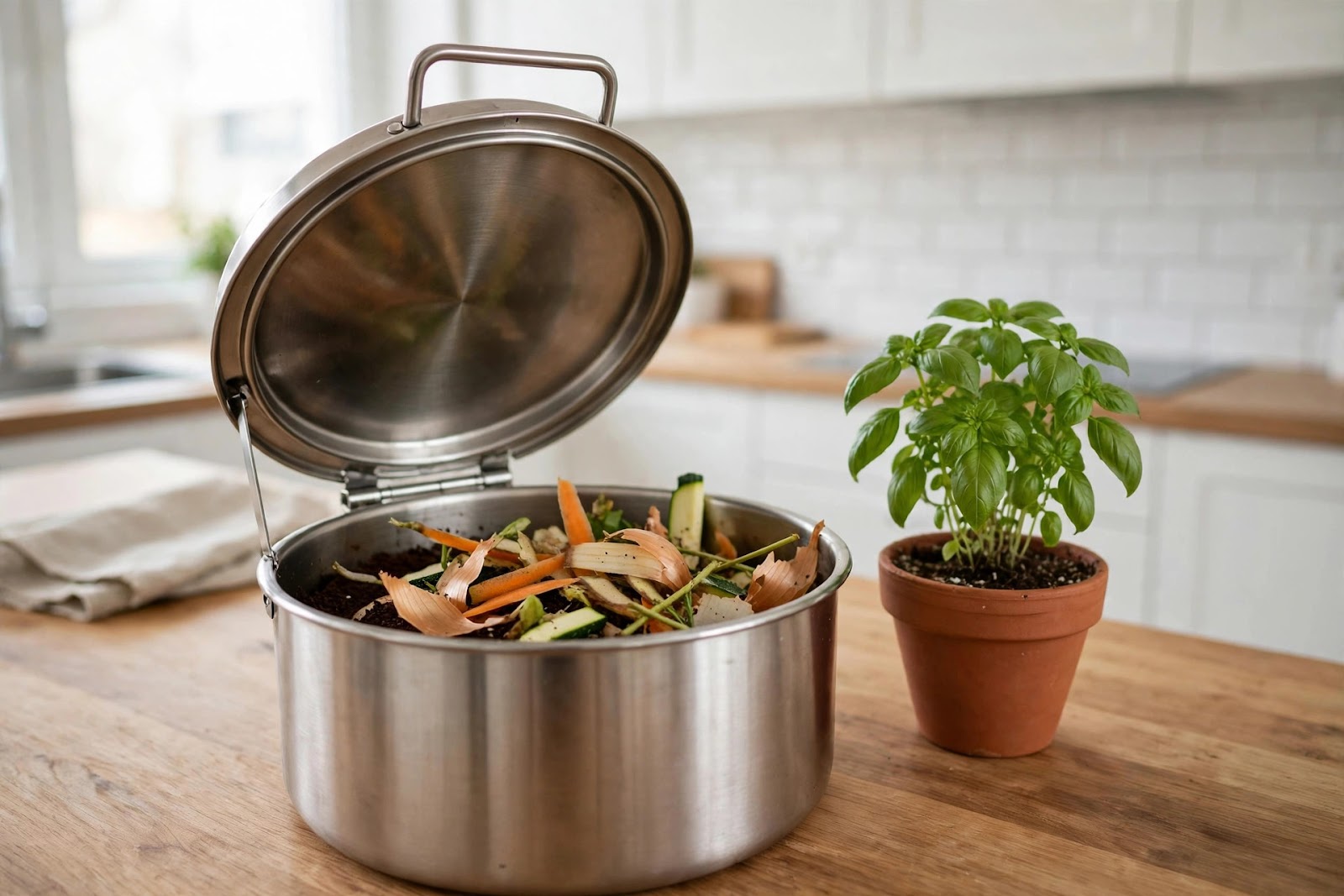
So I went with the third option: a worm bin. Vermicomposting, if you want the proper word. A box of red wiggler worms that eat your scraps and turn them into worm castings — the dark, crumbly, sweet-smelling stuff that gardeners get embarrassingly excited about.
My bin is a 40-litre plastic storage box with a lid, the kind that costs about £8 at any hardware shop. I drilled twelve small holes in the lid and eight around the upper sides with a 6mm drill bit — air in, worms stay in. It sits under the kitchen sink on a folded old towel (to catch the odd drip), and it's about the size of a microwave. If you've got a cupboard, a balcony corner, or a spot under the stairs, you've got room for one of these.
Inside, the bedding is shredded cardboard and newspaper, torn into strips about the width of a finger, dampened until it feels like a wrung-out sponge. That's the worms' home. I added a small bag of red wigglers — about 500 grams, roughly 400 worms, £22 including delivery from a worm farm online. They arrived in a breathable bag inside a cardboard box, looking like a tangle of pink spaghetti, and I tipped them gently onto the bedding, put the lid on, and left them alone for three days. That's the hardest part of worm composting: leaving them alone.
Feeding the worms (and what not to feed them)
The feeding routine is the part everyone overcomplicates. Here's mine, and it's survived eighteen months.
Once a week, I take the frozen scrap bag out of the freezer, let it thaw for an hour, and bury it under the bedding in one corner of the bin. Burying matters — food on the surface attracts fruit flies; food under the bedding doesn't. I rotate corners each week so the worms work through the bin evenly. Then I add a handful of shredded cardboard on top, close the lid, and forget about it for another week.
The worms eat roughly their own weight in food per week once they're settled in, so 500 grams of worms handles about 500 grams of scraps a week. That's most of a one-person household's vegetable waste, honestly. I cook most nights, and a week's scraps — peelings, cores, coffee grounds, tea leaves — comes to about 400 grams. It fits.
What goes in: fruit and vegetable peelings and cores, coffee grounds and paper filters, tea bags (only the plastic-free ones — check the box, many still contain plastic), eggshells crushed up small, bread in small amounts, and shredded cardboard and newspaper. What stays out: meat, fish, dairy, oil, citrus in large amounts, onions and garlic in large amounts, and anything cooked in a lot of fat. The worms can technically handle small amounts of most things, but the stuff on the no-list is what causes smells and fruit flies. I tried feeding them a lemon half once, in week three, full of confidence. The worms avoided it for a week and the bin smelled faintly of cleaning product. Lesson learned: citrus goes in the outside bin, in small amounts, and nobody dies.
The single best feeding tip I picked up: freeze the scraps first. Freezing breaks down the cell walls of the vegetables, so the worms eat them faster, and it kills any fruit fly eggs hiding on a banana peel. My freezer bag does double duty — no smell in the kitchen, faster composting in the bin.
The fruit fly incident (and how I fixed it in a day)
I promised honesty, so here's the one time the system failed. In month four, I got lazy for two weeks — I stopped burying the food and just tipped it on top of the bedding, and I skipped the cardboard layer. Within days, there were fruit flies. Not a plague, maybe twenty of them, but twenty fruit flies in a small kitchen feels like a plague.
I fixed it in a day, and the fix is worth knowing because it works every time. First, I buried the exposed food under a thick layer of damp shredded cardboard. Second, I put a small dish of apple cider vinegar with a drop of washing-up liquid on the counter next to the bin — the flies drown in it, grim but effective. Third, I left the bin alone for a week with no new food. The flies were gone in three days and they never came back, because I never skipped the burying step again. The whole episode taught me that the system is forgiving if you catch it early, and that every single worm-composting problem I've ever had came back to one of two things: food on the surface, or too much wet and not enough dry.

Harvesting: the best part
After about four months, the bin was full of dark, crumbly castings that smelled like fresh earth after rain. That's the moment you know it's working — finished worm compost doesn't smell like anything except soil. If your bin smells, it's not finished yet, or the balance is off. Add browns, wait, and it sorts itself out.
Harvesting takes about half an hour and I do it every four months or so. I push all the contents to one side of the bin and put fresh bedding and a little food on the empty side. The worms migrate toward the food over the next week, and then I scoop out the finished side — a tub of black gold, worm-free. The first harvest filled a 5-litre tub. I mixed it into the pots on my balcony — the basil, the mint, the one heroic tomato plant — and within a fortnight the basil had doubled in size. I'm not saying it was all the compost. I'm saying the basil had never looked like that before.
There will be a few stragglers, worms that didn't get the memo. I pick them out by hand and put them back in the bin. It takes five minutes and it's oddly satisfying, like weeding. If you hate touching worms, use gloves — but honestly, after a month you stop noticing. They're just part of the kitchen now, quiet little colleagues under the sink.
The costs, the time, and the honest maths
Total setup cost: the box £8, the drill holes free (I borrowed a drill), the worms £22, a bag of shredded cardboard free from the recycling. That's £30 all in, and the bin has been running for eighteen months with no further spending except the occasional bag of worms' worth of cardboard, which is to say, free.
Time: about ten minutes a week. Thirty seconds a day for the freezer bag, five minutes on Sunday to feed the bin, and a half-hour harvest every four months. The first month took more time because I was checking the bin every day like a nervous parent. Now it's a background habit, like taking the bins out.
What it saves: my kitchen rubbish dropped from three bags a week to one, and the food-waste portion of it went to almost nothing. The council charges for extra bags where I live, so that's a real saving, but the bigger saving is the compost itself — a 5-litre bag of decent compost costs about £6 at a garden centre, and I harvest that much every four months for free. It's not going to make anyone rich. But £30 of setup, ten minutes a week, and I never buy compost and never throw food in the bin? That's a trade I'll make every time.
The smell test, eighteen months on
People always ask the same question, and it's the only question that matters: does it smell? So here's the honest answer, eighteen months in.
The freezer bag smells of nothing, because it's frozen. The worm bin smells of nothing when you open the cupboard — genuinely nothing. If you lift the lid and put your nose right in, it smells like damp earth and cardboard, which is the smell of a forest floor, not a bin. My flatmate, the same one who opened the cupboard in silence on the day of the first disaster, now puts her own coffee grounds in the freezer bag without being asked. That's the real review.
If you're in a tiny apartment and you've always assumed composting needs a garden, it doesn't. It needs a freezer bag, a box under the sink, some shredded cardboard, and about ten minutes a week. The worms do the rest, quietly, in the dark, while you get on with your life. The first attempt I made failed because I skipped the reading and blamed the idea. The second attempt worked because I learned the two rules that matter: keep it dry enough, and bury the food. Everything else is just patience.
Start with the freezer bag this week. Don't buy anything yet — just freeze your scraps for seven days and see how much you were throwing away. If the bag fills up and you're curious, that's when you get the box and the worms. And when your basil doubles in size, you'll know exactly why.


