My kitchen sponge used to have a smell. Not a dramatic smell, not a bin-day smell — just that faint sour whiff you catch when you pick it up to wipe the counter. I told myself it was normal. Sponges smell. That is what they do. Then one morning I squeezed it out, caught the smell properly, and realised I had been wiping my plates with something I would never have wiped my face with.
I binned it. Then I did what I always do when a small household thing annoys me: I stood in the cleaning aisle for too long, reading packets. The yellow-and-green sponge I had always bought cost about 80p for a pack of three. Next to it sat a pack of compostable sponges for £4.50. Five times the price, for something I throw away anyway. I bought the cheap ones out of habit, went home, and spent the evening wondering whether the expensive ones were a scam or the cheap ones were.
That question turned into a three-month experiment. I tried the compostable sponges, a coconut-fibre scrub, a loofah, and the Swedish dishcloths everyone online swears by. Some of it worked. Some of it fell apart in my hands, literally. This is the honest version of what stuck.
The sponge I was actually using
Let me be fair to the old sponge first. It was good at its job. The soft side soaked up spills, the green scouring side shifted dried porridge, and it fitted in my hand. I replaced it every two or three weeks, or whenever it started to smell, whichever came first. Usually the smell won.
What I did not think about was where it went. A standard kitchen sponge is polyurethane foam with a plastic scouring pad. It does not break down. Every sponge I have ever used is sitting in a landfill somewhere, still roughly sponge-shaped, and I have used hundreds of them. Two a month for fifteen years is 360 sponges. That number sat badly with me once I actually did the maths.
The other thing I had not thought about was the smell itself. A damp sponge is a warm, wet home for bacteria. I was rinsing it, wringing it, and leaving it in a little dish by the sink that never fully drained. No wonder it turned. The smell was not a sponge problem, really. It was a care problem. But the plastic part was real, and that was what I wanted to fix.
What I tried first: the compostable sponge
The first swap was the obvious one: a compostable sponge made of cellulose and a loofah scouring layer, sold as a pack of three for £4.50. That is £1.50 each, against about 27p for my old ones. I winced and bought them anyway.
First impressions were good. It felt firmer than my old sponge, and it held water well. The loofah side handled a burnt lasagne dish on the second night, which is my personal benchmark for any scrubber. It did not scratch my non-stick pan either, which the green scourer had occasionally done when I pressed too hard.
Then came the test that matters: the smell test. After a week of the same routine — rinse, wring, leave by the sink — it smelled no worse than the old sponge had at the same age. After two weeks it was still fine. At three weeks it was getting tired, the corners fraying a little, but it did not stink. I got a full month out of the first one, which changed the cost maths completely.

The cost maths, done honestly
Here is the comparison I wish someone had shown me before I stood in that aisle. My old sponge cost 27p and lasted about two and a half weeks. Call it 11p a week. The compostable sponge cost £1.50 and lasted four weeks. That is 37p a week. Three times the price, no getting around it.
But the gap is smaller than it looks on the packet, because the cheap sponge needed replacing more often. Over a year, the old sponge cost me about £5.70. The compostable one costs about £19.50. So yes, it costs me roughly £14 more a year. I decided that was worth it — a pound a month to stop sending plastic foam to landfill — but I will not pretend it is cheaper. It is not. It is a choice, and I made it with my eyes open.
One thing that did save money: I stopped buying a separate scouring pad. The compostable sponge's loofah side does the scouring, and the cellulose side does the wiping. Two jobs, one sponge. That is a small saving, but it simplifies the sink, which I value more than I expected.
The coconut scrubber that fell apart
Not everything worked. The second thing I tried was a coconut-fibre scrub pad, the kind that looks like a rough brown mat. It cost £3 for one. On paper it was perfect: natural fibre, compostable, tough on burnt food.
In practice, it shed. Every wash left little brown fibres in the sink and on the plates, and after ten days it had gone floppy in the middle and stiff at the edges, like a bad haircut. It scrubbed well — I will give it that, it took burnt rice off a pan faster than anything else I own — but I spent as much time picking fibres off the draining board as I saved scrubbing.
I used it for three weeks and then composted it, which was at least a dignified ending. I would not buy it again for everyday dishes. If you cook a lot of rice and burn it a lot, maybe. For me, it was a lesson: natural does not automatically mean practical.
The Swedish dishcloth surprise
The real surprise of the whole experiment was the Swedish dishcloth. I had heard about them for years and dismissed them as a fad. A cloth made of cellulose and cotton that replaces paper towels and sponges? It sounded like marketing. A friend gave me two as a gift, which is the only reason I tried them.
I was wrong. A Swedish dishcloth absorbs an astonishing amount of water — the packet says twenty times its weight, and while I have not weighed it, it soaks up a full spilled glass of water without dripping. It wipes counters clean, it rinses clean under the tap, and when it gets grubby you throw it in the washing machine or the top rack of the dishwasher.
Here is the part that sold me: it dries fast. Really fast. I drape it over the tap or the dish rack and it is dry within an hour or two, and a dry cloth does not go sour the way a damp sponge does. I have been using my first two for four months now, washing them about once a week, and neither of them smells. Four months. My old sponges never made it past three weeks without turning.
They do not scrub, though. That is the honest limitation. Dried porridge on a bowl needs the sponge or a brush. So my sink now has a system: one compostable sponge for scrubbing, one dishcloth for wiping, and a wooden dish brush for glasses and mugs. Three tools, all of them compostable or long-lasting, none of them plastic foam.
The routine that keeps them fresh
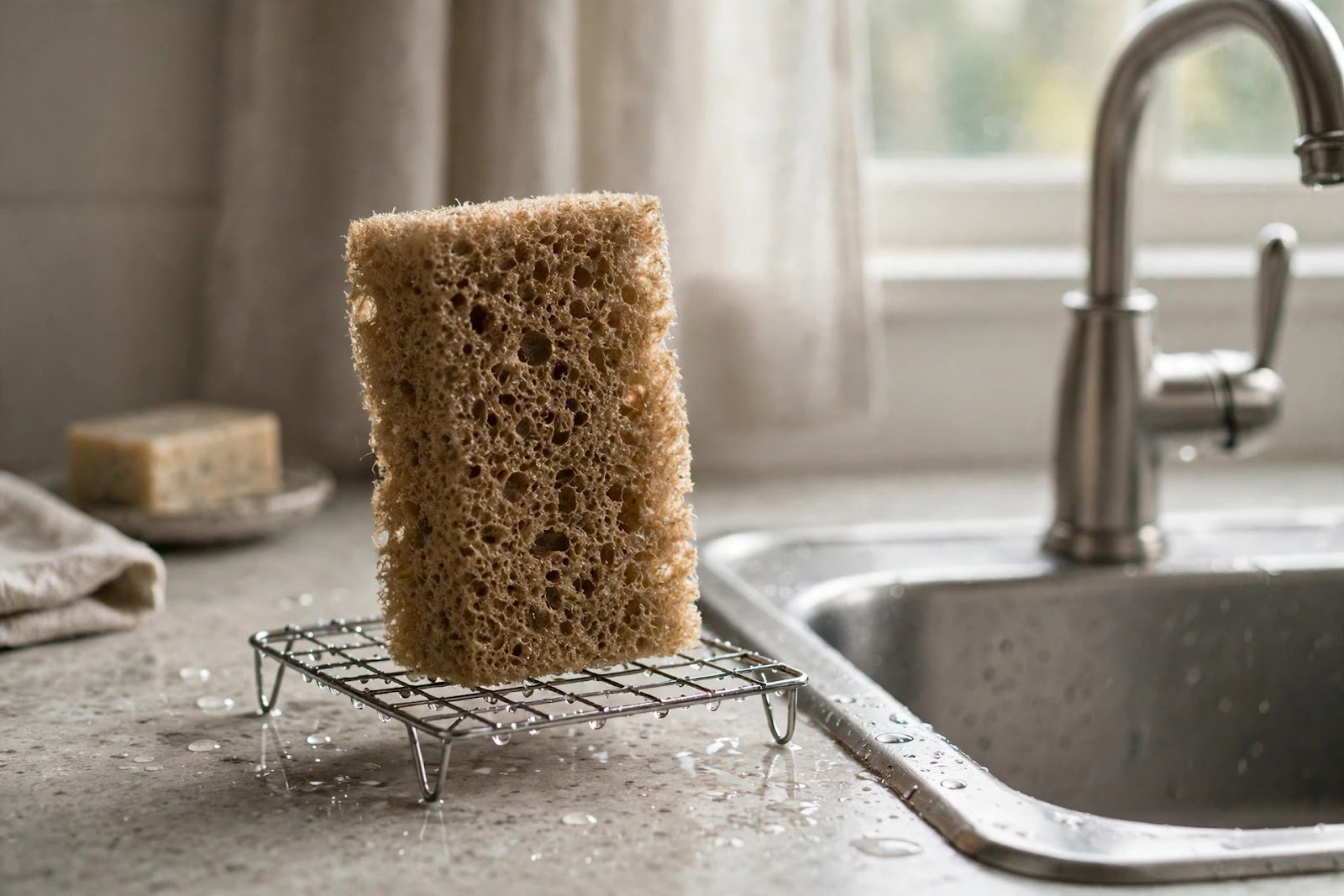
The biggest lesson of the three months was not about which product to buy. It was about care. Every scrubber lasts longer and smells better if it can dry out between uses. I drilled two small holes in the bottom of my sponge dish — or rather, I replaced it with a little wire soap dish that lets air through underneath. That one change made more difference than switching brands.
My routine now is simple. After the washing up, I rinse the sponge and the dishcloth well, wring them out hard, and stand the sponge on its edge so air reaches both sides. Once a week, the dishcloth goes in the laundry with the tea towels. The sponge gets a rinse in hot water with a drop of washing-up liquid, and a proper wring. When the sponge starts to fray or feel tired — usually around the four-week mark — it goes in the compost bin, and I take a fresh one from the pack.
One thing I check now: the compostable claim. Not every sponge with a green packet is actually compostable. Some are cellulose on one side and plastic scourer on the other, which means the whole thing is landfill. I check the label for what the scouring layer is made of, and I look for home-compostable wording rather than just "eco" or "green". If the packet will not say what it is made of, I do not buy it.
What I would tell a friend
If you want the simplest version of this, here it is. Buy a pack of compostable cellulose sponges and two Swedish dishcloths. Use the sponge for scrubbing and the cloth for wiping. Keep them somewhere they can dry. Wash the cloth weekly. Compost the sponge when it frays. That is the whole system, and it has worked for me for three months without a single sour smell.
It costs a little more. About £14 a year more, by my maths, against the cheapest plastic sponges. I think of it as a pound a month for a sink that does not stink and a bin that is not full of foam. Your mileage may vary, and if money is tight, the dishcloths alone are the best value — they last months and replace both paper towels and half your sponge use.
The old yellow sponge is gone from my sink, and I do not miss it. What I notice now is a small, silly thing: the sink area smells of nothing. No sour sponge, no damp cloth, just clean water and washing-up liquid. It took me years of tolerating that smell to realise I did not have to. If your sponge smells when you pick it up, you already know what to do.


