I bought the mushroom kit on a whim, the way you buy a scratch card. It was £12.50 at the garden centre, a damp cardboard box with a hole in the side and a promise printed on the front: fresh oyster mushrooms in two weeks. I had a jar of sprouts going on the windowsill and a vague sense that I was the kind of person who grows things now. The box sat on top of the fridge for three days while I found reasons not to start it.
Then I read the instructions properly, and they were so simple I felt slightly cheated. Cut an X in the plastic, soak the block overnight, mist it twice a day, wait. No soil, no pots, no digging. The block itself was straw and sawdust, already colonised with white mycelium that looked like frost. My job was just to keep it damp and stay out of the way.
The first flush, and the day I nearly killed it
The first pins appeared on day six. Tiny grey-blue nubs pushing out of the X, no bigger than lentils. I misted them like a nervous parent and checked them every hour, which is the fastest way to make anything feel slow. By day nine they were unmistakable mushrooms, fanning out in a shelf, pale grey with edges that curled like paper.
On day ten I forgot to mist them before work. I came home to a cluster that had gone leathery at the edges, the caps dry and curled inward. I soaked a tea towel, draped it over the box, misted everything in sight, and hoped. By morning the caps had softened again, though the smallest ones never recovered. Lesson one, learned the hard way: mushrooms forgive a missed morning, but they do not forgive a missed day. Twice a day, every day, no exceptions. I set a phone alarm for 7 a.m. and 7 p.m. and stopped relying on memory.
I harvested the first flush on day twelve. Two hundred and forty grams, weighed on the kitchen scale because I wanted a number, not a feeling. I fried half of them that night in butter with garlic and a pinch of salt, and they were genuinely good. Meaty, a little nutty, nothing like the tired supermarket oysters that go slimy in the bag before you use them.
What the second flush taught me about patience
After the first harvest the instructions said to rest the block for a week, then soak it again overnight and start over. I did not believe a second flush would come. The block looked spent, shrunken, like a wet sponge left in the sink. But I soaked it, drained it, put it back on the fridge, and on day five of round two the pins were back.
The second flush was smaller, 160 grams, and slower. The third flush gave me 90 grams and caps the size of coins. That is the honest shape of it: each round gives you less, and by the third you are mostly doing it for the fun of it. Total from one £12.50 kit: 490 grams over about five weeks. The same mushrooms cost roughly £8 a kilo at the supermarket, so I spent £12.50 to grow about £4 worth of mushrooms. Do the maths before you start, because the kit is a hobby, not a saving.
So why am I writing about it? Because the kit taught me the method, and the method is where the real value sits. A kit is just a block of colonised straw. Once you understand that, you can make your own.
The coffee grounds experiment

This is the part I actually got excited about. Oyster mushrooms will grow on used coffee grounds, which most of us throw away every morning. The grounds are already pasteurised by the hot water, they are full of nitrogen, and they cost nothing. I had been saving mine in a tub on the counter for a week, which was my first mistake. Fresh grounds are fine. A week-old tub of damp grounds in a warm kitchen is a mould farm.
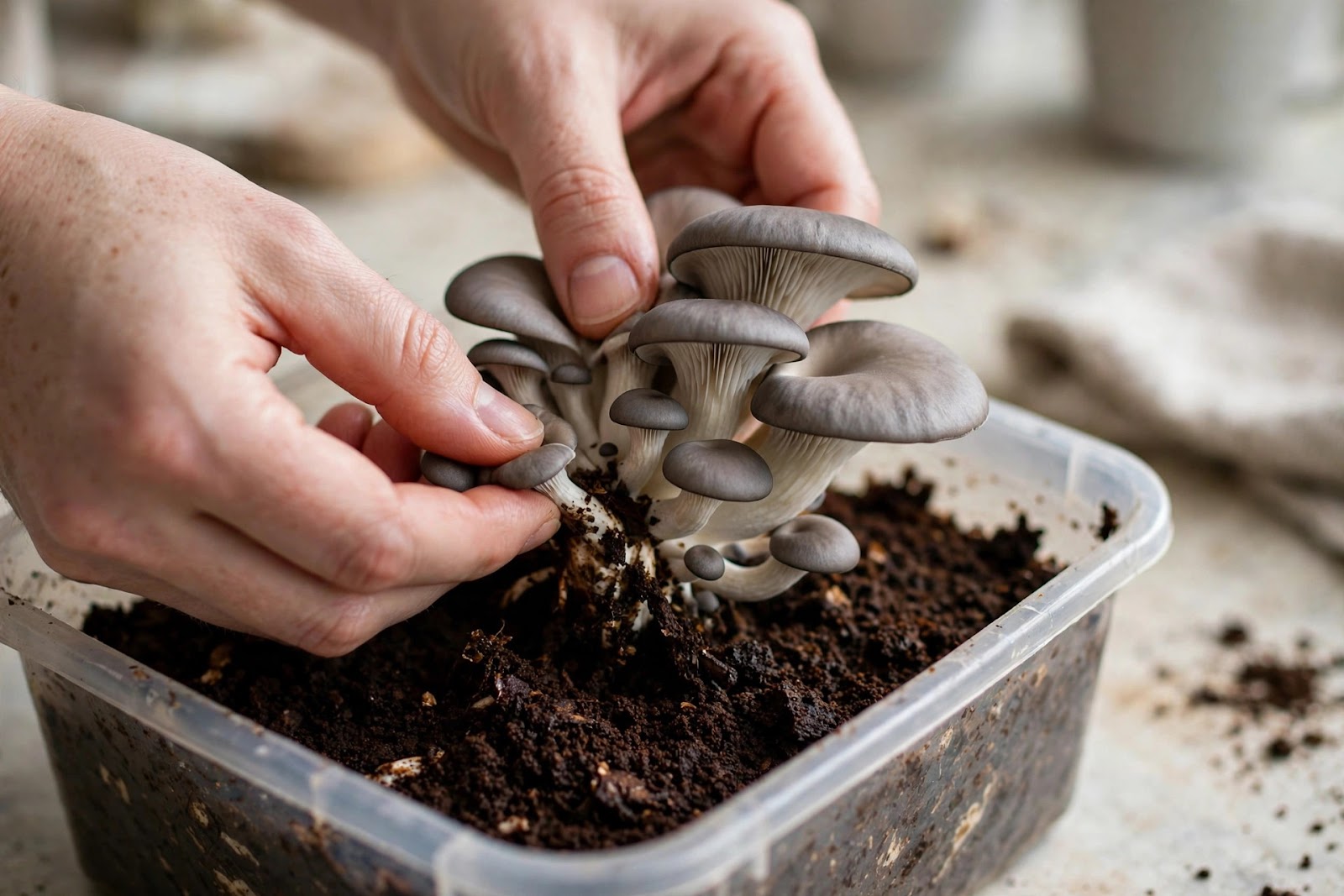
I started again, properly. I collected one day of grounds, about 300 grams, from my cafetiere. I let them cool, then mixed in a handful of the white mycelium I had teased from the corner of the spent kit block. I packed the mix into a clean plastic tub with holes punched in the lid, and I put it in a dark cupboard. Then I waited, misting nothing, touching nothing, for ten days.
Nothing happened for a week. Then white threads began to spread through the grounds like frost on a window. By day fourteen the whole tub was white. I moved it to the kitchen shelf, misted the holes twice a day, and on day nineteen, pins. Small, grey, perfect. That flush gave me 110 grams, and it cost me nothing but the grounds I was throwing away anyway.
The catch is contamination. My second tub went green with mould on day eight and I binned the lot. The difference between the two attempts? The first tub I packed the same day I brewed the coffee. The second tub sat for two days while I was busy, and something else moved in first. Fresh grounds, clean hands, clean tub. That is the whole secret, and it is not negotiable.
What I would do differently next time
First, I would skip the second kit and buy a bag of grain spawn instead. A 500-gram bag of oyster spawn costs around £8 online and will inoculate five or six tubs of coffee grounds. That turns a £12.50 novelty into a routine that actually pays for itself.
Second, I would keep the kit in the bathroom, not the kitchen. The bathroom stays humid after showers, and my mushrooms were visibly happier on the days I left the door shut after a shower than on dry winter days when the heating was on. If your house is dry, a clear plastic bag with a few slits over the box works as a humidity tent. I rigged one from a freezer bag in week three and the caps stopped drying out.
Third, harvest earlier than you think. I left my biggest cluster an extra day because it looked impressive, and by morning it had dropped spores all over the shelf, a fine grey dust that took three wipes to shift. Pick them when the caps are still slightly cupped underneath, not flat and flared. Younger mushrooms fry better anyway.
How I actually cook them
Oyster mushrooms are not button mushrooms, and cooking them like button mushrooms is a waste. They hold a lot of water, so a crowded pan steams them into rubber. One layer, hot pan, no salt until the end, and do not touch them for two full minutes. Let them brown. Then flip, add butter and garlic, and take them off the heat while they are still a little firm in the middle.
My best use for a homegrown flush is a ten-minute stir-fry: mushrooms, a splash of soy sauce, a pinch of chilli flakes, spring onions, over rice. Or torn into strips, tossed in a little oil and smoked paprika, roasted for fifteen minutes, and eaten in a wrap like pulled pork. My partner, who is sceptical of every project I drag home, asked for the roast version twice in one week. That is the real review.
One warning: if you have a mushroom allergy, or anyone in the house does, skip this entirely. And do not go foraging wild oyster mushrooms on the strength of this article. Growing a known strain in a tub is one thing. Identifying fungi in the wild is a different skill, and getting it wrong is not a funny story.
What to do when they all come at once
The awkward truth about mushrooms is that they do not ripen one at a time like tomatoes. A flush arrives all at once, and you have 490 grams of something that goes slimy in four days. My first harvest sat in the fridge while I dithered, and a third of it went soft before I used it.
Now I have a rule: harvest day is cooking day. Half gets fried and eaten that night. The rest gets sliced, fried hard until the water is gone, and frozen flat in a bag. Frozen this way they keep for two months and go straight from the bag into a pan, no defrosting. I have also dried a batch in the oven on its lowest setting for three hours, then blitzed the pieces into a powder that I shake over pasta and soup. A teaspoon of that powder has more flavour than a whole punnet of tired shop mushrooms, and the jar sits in the cupboard for months.
Do not wash oyster mushrooms under the tap. They soak up water like a sponge and then steam instead of frying. A dry brush or a quick wipe with a damp cloth is all they need. If the stems feel tough, tear them into strips and use them in stock, or just cut the tough ends off and compost them. The caps are the prize.
Is it worth it?
The kit on its own? As a money-saver, no. As a way to learn the method in two weeks without any faff, yes, absolutely. The coffee-ground tubs after it? Those are the real deal. Free substrate, a £8 bag of spawn, and a shelf in a humid corner of the house, and you have fresh mushrooms every few weeks for the price of the spawn.
I still buy mushrooms at the shop most weeks. I am not pretending a tub on my shelf feeds the household. But every few weeks a little grey cluster pushes out of a tub of yesterday's coffee, and I fry it for breakfast, and it tastes better than anything from a plastic bag. Start with the kit, learn the rhythm of misting twice a day, and then try one tub of coffee grounds. The kit teaches you the habit, and the habit is the whole game.


