I Kept My Old Phone Alive for Four Years — The Battery Swap, the Cracked Screen, and What It Actually Cost
My phone turned four years old this spring, and I celebrated by doing absolutely nothing about it. No unboxing video, no trade-in form, no two-year contract with a shiny new rectangle. Just the same scuffed handset I bought back when it still felt fast, still in its third case, still doing everything I actually need a phone to do.
That sounds like a small thing. It is not, if you have ever stood in a phone shop while a cheerful salesperson explains that your perfectly working device is basically a museum piece. The pressure to upgrade is constant and weirdly personal. Friends ask when I am getting a new one. My banking app sends me warnings about my operating system version. Even my phone itself started suggesting I back everything up, as if it knew its days were numbered.
I am not anti-technology. I like new gadgets as much as anyone. But I started doing the maths one evening when my battery died at 3 p.m. for the third day in a row, and the numbers refused to add up in favour of a new phone. A replacement handset I actually wanted cost a small fortune, and the one in my hand still took decent photos, still ran every app I used, still fit in my pocket. The battery was the problem, not the phone. So I decided to fix the battery and see how long I could keep going. Four years later, I am still going.
The first thing people ask is whether it was hard. It was not hard. It was slow, occasionally annoying, and surprisingly satisfying, in the same way fixing a wobbly chair is satisfying. You end up knowing your own stuff better. You stop treating a phone like a disposable cup and start treating it like a tool you maintain. That shift in attitude turned out to be the whole point.
Why I refused to upgrade when everyone else did
The upgrade itch hit hardest around the two-year mark. That is when the adverts start finding you. My old phone was still under no contract, the screen had one hairline scratch, and suddenly every website I visited wanted to sell me its successor. The new model had a slightly better camera, a slightly faster chip, and a colour I did not need. I almost caved in a shopping centre one Saturday, standing in front of a display table, holding a phone that felt exactly like mine except lighter and shinier.
What stopped me was the trade-in offer. They would give me a small amount for my old phone, then lock me into monthly payments that added up to far more than the phone was worth. I did the sums on my own phone calculator, right there in the shop, and felt embarrassed for almost falling for it. The monthly figure looked small. Multiplied by twenty-four months, it did not.
I went home and made a list instead. What did I actually use my phone for? Calls, messages, photos of my garden, maps, banking, podcasts, and an embarrassing amount of time scrolling through recipes I never cook. None of that needed the newest chip. None of it needed a camera that could photograph the moon. My phone already did all of it. The only thing it did badly was hold a charge past lunchtime, and that was a battery problem with a battery solution.
The other reason was waste, plain and simple. I had read enough about the materials inside phones to know that a new handset is not just a box and a screen. It is mined metals, factory energy, packaging, shipping, and a whole supply chain, all for a device I would use mostly to check the weather. Keeping mine going for another year or two felt like the single biggest low-waste choice I could make without changing anything else about my life. No new habit to learn, no sacrifice, just not buying a thing I did not need.
The battery swap that started it all
The battery was the whole story at first. By year two, my phone would drop from full to half by mid-morning, then die dramatically at about 20 percent, as if 20 was its personal quitting point. I carried a power bank everywhere, which meant I was carrying two devices to do the job of one, and the power bank itself needed charging, which felt like a joke I was playing on myself.
I looked up a battery replacement at the manufacturer service centre first. The price made me wince but it was honest: a genuine battery, fitted by someone who did it all day, with a warranty. Then I looked up the independent repair shop on my high street, the one with the hand-painted sign and the bell on the door. Their price was about half. I stood outside that shop for a full minute, weighing the risk, before I walked in.

The man behind the counter did not try to sell me anything. He looked at my phone, asked how long I had owned it, and said the battery was a straightforward job, about forty minutes, and I could wait in the cafe next door. He also warned me, without being asked, that a cheap battery would swell or die within months, and that he only fitted decent ones. That honesty sold me more than any discount would have.
Forty minutes later I had a phone that lasted a full day again. It felt like a new device, which is a strange thing to say about a phone I had owned for two years. I stopped carrying the power bank. I stopped checking the battery percentage every hour like a nervous parent. The whole fix cost less than one monthly payment on a new phone contract, and it bought me another year and a half before the battery even started to fade again.
I made one mistake in this chapter, and I will tell you because it is the kind of mistake that costs real money. A year after the first swap, a different shop offered me a battery for almost nothing, and I said yes without asking what brand it was. It lasted four months. It swelled slightly, which I only noticed because my case stopped sitting flush, and the shop that fitted it had closed by then. Lesson learned the expensive way: a battery is not the place to hunt for the cheapest possible price. Pay for a decent one, from a shop that will still be there next month, and keep the receipt.
The cracked screen and the case that finally worked
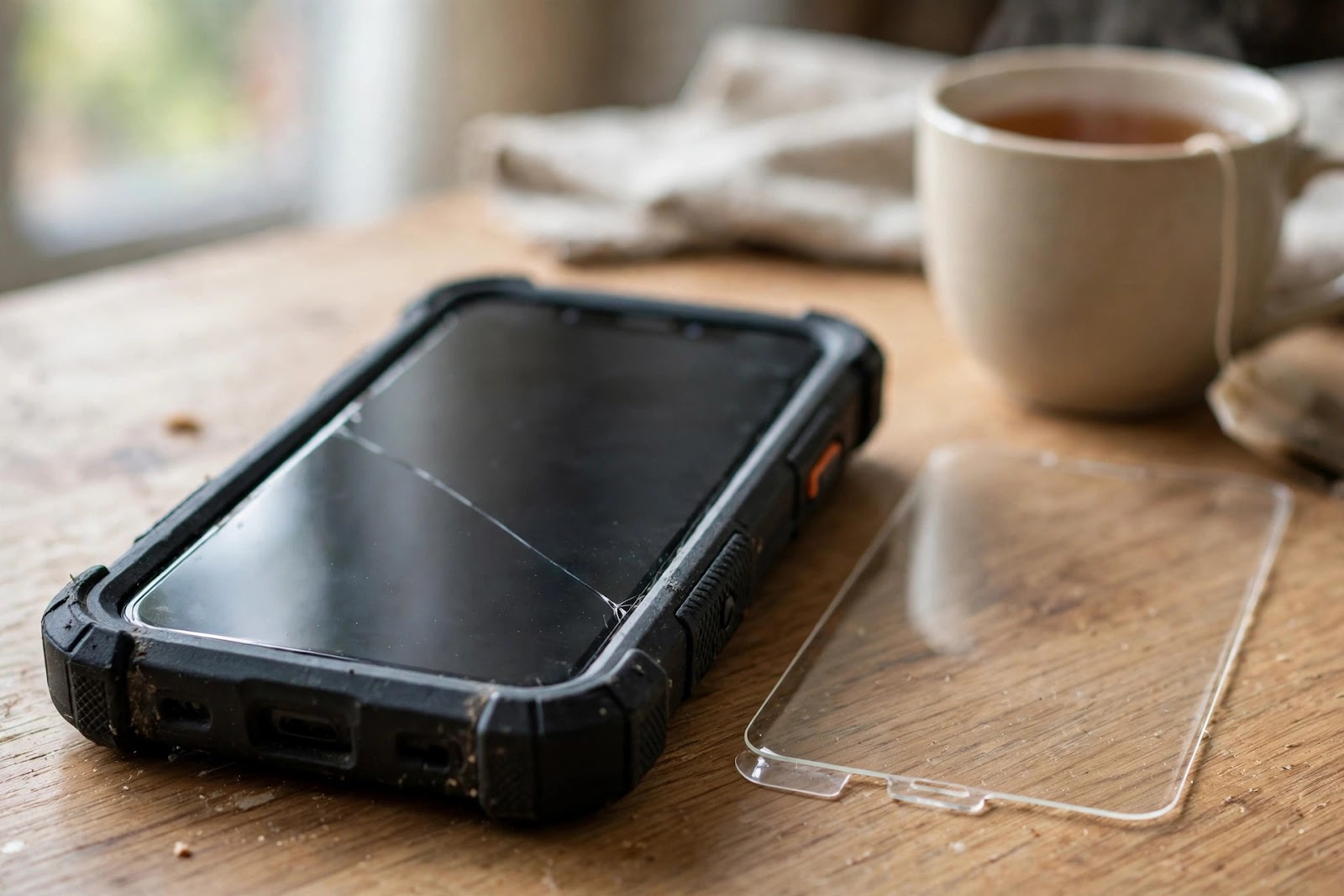
If the battery was a slow decline, the cracked screen was a sudden disaster. I dropped my phone on a concrete step while carrying a bag of compost, which is exactly the kind of undignified accident that sums up my life. The screen did not shatter. It cracked in one clean line from the top corner down to the middle, like a lightning bolt frozen in glass. The phone still worked perfectly. The crack just sat there, catching the light, mocking me.
For three weeks I did nothing. I told myself it added character. It did not add character. It caught my thumb every time I swiped, and it made the phone look like something I had found in a skip. Then a friend pointed out, very reasonably, that a cracked screen is how water and dust get inside a phone and kill it properly. That got my attention.
A screen replacement cost more than the battery, enough that I hesitated. I got two quotes. The manufacturer wanted a price that made me laugh out loud in the shop. The independent shop wanted about half that, with a screen that was not original but was, in their words, perfectly good. I asked them to be specific about what perfectly good meant. They said the colours would be a touch less vivid and the glass a touch less tough, but touch response and brightness would be fine. I took the cheaper option and I have never regretted it, though I will admit the colours are a tiny bit flatter. I stopped noticing after a week.
The real lesson was the case. After paying for a new screen, I finally bought a proper protective case instead of the slim pretty one I had been using. The new case is ugly. It is thick, it has reinforced corners, and it makes the phone look like it is wearing a life jacket. It has also saved the phone at least four times since, including one drop down a flight of stairs that left the case scuffed and the phone completely unharmed. I used to choose cases for how they looked. Now I choose them for how they bounce.
I also put a tempered glass screen protector on, which is the single best few pounds I have spent on this phone. It has cracked twice in the line of duty, and both times I peeled it off, stuck a new one on, and carried on as if nothing had happened. The actual screen underneath is still perfect. If you take one practical thing from this article, let it be this: a glass protector and a chunky case cost less than one screen repair, and they turn most drops into non-events.
The storage squeeze and the great photo cull
Year three brought a different problem: storage. My phone warned me it was almost full, and it was right. Thousands of photos, most of them duplicates, had piled up like laundry on a chair. I had pictures of the same tomato plant from seventeen angles, blurry shots of the dog mid-sneeze, and screenshots of recipes, bus timetables, and parcel tracking numbers from two years ago. The phone was not slow because it was old. It was slow because it was carrying around my entire digital attic.
Clearing it out took one rainy Sunday afternoon and a mug of tea, and it made a bigger difference than I expected. I deleted duplicate photos ruthlessly, moved the keepers to a free cloud backup, and uninstalled apps I had not opened in months. There was a fitness app I downloaded in January and used twice. There were three different weather apps, which is two too many by any measure. There was a game my nephew installed that I had forgotten existed.
The phone felt faster the same evening, and the battery lasted a little longer too, because it was no longer working overtime to index thousands of files. I now do a ten-minute clear-out on the first Sunday of every month, and it has become a small ritual. Delete the blurry ones, back up the good ones, uninstall the app I downloaded for one specific task and never used again. It is boring maintenance, like cleaning a filter, and it works for exactly the same reason.
The slowdown, the updates, and what I turned off
Around the same time, the phone started feeling sluggish in a way I could not blame on storage. Apps took a second longer to open. The camera hesitated before taking a photo. I assumed this was the phone getting old, and for a while I used it as evidence that I needed a new one. Then a friend who fixes computers asked me a simple question: how many apps were running in the background? The answer was all of them, apparently, because I never closed anything.
I spent an evening going through the settings properly for the first time since I bought the phone. I turned off background refresh for apps that did not need it. I turned off location access for apps that had no business knowing where I was. I switched the screen to a slightly lower brightness and turned on the battery saver mode that I had been ignoring because it sounded like something only anxious people used. None of this was dramatic. All of it added up.
The operating system updates were a mixed story. I used to install every update the moment it arrived, then wonder why my battery drained faster for a week. Now I wait a few days, check whether other people with my model are reporting problems, and then install. I also stopped installing the big annual update on day one, because the first version always seems to have a bug that gets fixed a fortnight later. Patience turned out to be a perfectly good tech strategy.
What it actually cost, in real numbers
Here is the part I wish someone had shown me before I upgraded my last phone: the honest maths. A new handset of the kind I would actually buy costs a large sum upfront, or a monthly payment that quietly adds up to even more over two years. My four-year-old phone, kept alive, cost me a battery replacement, a screen replacement, two tempered glass protectors, one chunky case, and a second battery that I should not have bought from the cheapest shop in town. Add it all up and the total is still a small fraction of a new phone, and the phone I ended up with does everything the new one would do for the way I actually live.
I am deliberately not giving you a single neat total with a pound sign, because prices vary by model and by town, and a fake precise number would be worse than an honest range. But the shape of it is this: each repair cost less than two months of a typical new-phone contract, and each one bought me a year or more of extra life. The case and the screen protector together cost less than a single month of that contract. The cloud backup for my photos costs a few pounds a month, and I would have paid that with a new phone too.
There is also the hidden cost of switching, which nobody mentions in the adverts. Setting up a new phone takes an evening: signing in to everything, moving photos, finding passwords, discovering that one app you need has changed its name. I have done it before and I remember the faff. Keeping my old phone cost me zero evenings of setup. That is worth something, especially when you would rather be doing literally anything else.
The environmental side matters to me too, and I will not pretend it is the only reason, but it is a real one. Every phone kept in use for an extra year is a phone that does not need to be manufactured, packaged, and shipped. The most sustainable phone is the one you already own. That line gets repeated a lot, and it gets repeated because it is true. My old phone is not a compromise I am enduring. It is a choice I am happy with, and the money I did not spend went towards things I actually wanted, like a decent pair of walking boots and a weekend away.
What I would do differently next time
If I could go back to the day I bought this phone, I would change three things. First, I would buy more storage, as I said. Second, I would put the chunky case and the glass protector on from day one, instead of waiting until after the first expensive drop taught me the lesson. Third, I would replace the battery at the first sign of trouble instead of carrying a power bank around for six months like a person who enjoys extra weight in their pocket.
I would also keep a small note of what I spend on the phone, the way I do for the car. Not because I am obsessed with spreadsheets, but because it stops the upgrade itch in its tracks. When a salesperson tells me my phone is old, I can look at my own notes and see that it costs me almost nothing to run and works perfectly well. Facts beat sales patter every time.
Would I recommend this to everyone? Honestly, no, and I want to be straight about that. If your phone genuinely cannot run the apps you need for work, or the battery dies within an hour no matter what you do, or the screen is so damaged you cannot read it, then keeping it alive is not thrift, it is stubbornness. There is a line, and I came close to it once when the cheap battery swelled. The point is not to suffer for the sake of it. The point is to check whether the phone is actually broken, or whether you have just been told it is broken by people who sell phones.
For most people, I suspect the truth is somewhere in the middle. Your phone probably has another year in it, maybe two, if you replace the battery, protect the screen, and clear out the digital clutter. Try the cheap fixes first. See how it feels. You might be surprised by how little you miss the newest model, and by how good it feels to know your own phone properly, cracks and all.
My phone is four years old now, and I have no plans to replace it this year. The battery holds, the screen is clear, the case is ugly, and the photos of my tomato plants are as sharp as ever. When it finally dies properly, I will buy a replacement and I will try to keep that one for four years too. By then, I will know exactly how.


