I found the first hole on a Sunday morning, pulling my favourite grey jumper over my head and catching my thumb on something that shouldn't have been there. A hole the size of a five-pence coin, right on the front, just below the ribs. I stared at it for a good ten seconds, the way you stare at a scratch on a car you love. Then I found a second one near the cuff. Then a third, smaller, hiding in the fold of the elbow.
Moths. Of course it was moths. The jumper had spent the summer folded in a drawer, and something in there had spent the summer eating it.
That jumper was five years old. I'd bought it in a sale for £35, worn it probably two hundred times, and it still looked good — apart from the holes. My first instinct was to bin it. My second instinct was to look up whether you could fix a moth hole in a knitted jumper. The answer was yes — and not as hard as I feared, though much harder to do neatly than the cheerful videos make it look.
This is the story of my first year of darning — the jumpers I saved, the sock I made worse, and the stitches that are still holding a year later. If you've got a drawer with a holey jumper in it, this is for you.
Why I bothered (and why it took me a month to start)
I'll be honest: my first reaction to the moth holes was to feel a bit embarrassed. Darning is something grandmothers did. I put the jumper back in the drawer and didn't touch it for a month. In that month I bought a replacement jumper for £28, wore it twice, and didn't like it as much. It was thinner, the colour was slightly wrong, and the cuffs stretched out by the second wash.
That was the moment the maths clicked for me. The old jumper had cost £35 and lasted five years. The new one cost £28 and already felt tired after two wears. Throwing away good wool because of three small holes wasn't just wasteful — it was bad value. I ordered a darning mushroom and a pack of needles, and I watched three different video tutorials in one evening, which is how I know the first thing nobody tells you: the videos make it look easy because the person filming has done it five hundred times. Your first attempt will not look like that. Mine certainly didn't.
I also did the boring-but-necessary bit first: dealing with the moths. There's no point darning a jumper and putting it back in a drawer full of moth larvae. I emptied the drawer completely, vacuumed it, wiped it down, and washed everything that had been in it. I put cedar blocks in the drawer afterwards, and I check them every few months. A year on, no new holes in anything.
The kit: what you actually need (it's not much)
Here's the full list of what I bought. A wooden darning mushroom, £6. A pack of darning needles — the long ones with the big eyes — £3. A small pair of sharp embroidery scissors, £5. And yarn, which cost me nothing at first because I raided my mum's knitting basket.
That's it. Fourteen pounds, plus yarn. No special frame, no loom, no kit with forty pieces you'll never use. I know people who darn with a jam jar or a lightbulb instead of a mushroom — anything smooth and round that you can stretch the fabric over works. A tennis ball does the job for socks. The mushroom is nice because it's flat on one side so it sits still on the table, but it's a convenience, not a necessity.
Yarn choice matters more than the tools. The golden rule I learned: match the weight of the yarn to the weight of the garment. My grey jumper is a medium-weight knit, so I used a standard double-knitting yarn in a matching grey. Matching the colour exactly is nice but not essential — my first darn used a slightly darker grey because that's what was in the basket, and from more than a metre away, you can't tell.
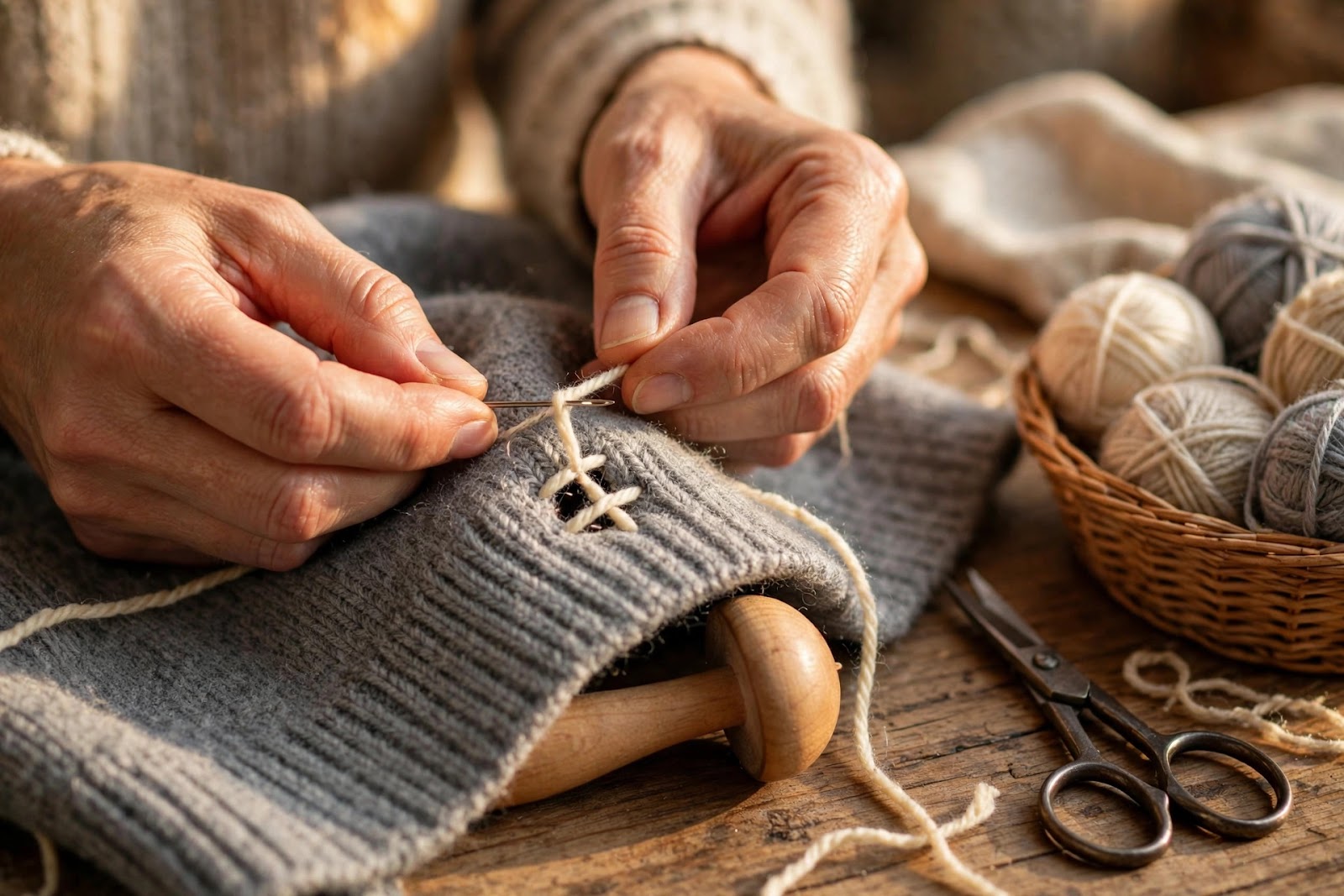
One thing worth spending on: needles with big eyes and blunt tips. Sharp needles split the wool fibres. Blunt tapestry needles slide between the stitches instead of through them, and the big eye means you're not fighting to thread the yarn every five minutes.
My first darn: a wonky, lumpy, beloved mess
I started with the smallest hole, the one at the elbow, because if I ruined it, it would be the least visible. I stretched the jumper over the mushroom, threaded the needle with a length of yarn about as long as my forearm, and I started.
The technique is called a woven darn, and the idea is simple: you weave a little patch of new fabric across the hole, over and under, like a tiny loom. First you run straight lines across the hole in one direction, anchoring them in the good knitting around the edges. Then you weave back across them at right angles.
My first attempt had three problems. First, I pulled the yarn too tight. Every stitch puckered the fabric around it, so the darn sat in a little dent. Second, my rows were uneven — some close together, some with gaps you could see through. Third, I anchored the yarn too close to the hole's edge, so the edges frayed a little more over the next few weeks. The result looked like a small grey spider had built a web on my elbow. I wore the jumper anyway, to the shops, and nobody said a word. That gave me the courage to do the bigger holes.
Here's what I changed on the second attempt, and this is the most useful thing in this whole article: I stopped trying to make it invisible and started trying to make it strong. A darn that tries to be invisible and fails looks like a mistake. A darn that is openly a repair — neat, even, a slightly different shade — looks like a choice. I anchored my yarn a full centimetre into the good knitting around the hole and kept the tension loose, barely snug. The second darn took twenty minutes and looked five times better than the first. The third took fifteen minutes and looked better still.
Swiss darning: the trick that changed everything
About a month after the moth jumper, I found a different kind of damage: a thin spot on my navy jumper, on the shoulder where my bag strap rubs. No hole yet, just the knitting going thin and shiny, the way a carpet goes thin in a doorway. A woven darn would have worked, but a woven patch on a thin spot looks heavy. So I tried Swiss darning instead — also called duplicate stitch, where you follow the path of the original yarn, stitch by stitch, laying new yarn directly over the old stitches. Done well, it blends in almost completely.
I used Swiss darning on the thin shoulder, working a patch about four centimetres square over the worn area, in matching navy yarn. It took about forty minutes, start to finish. A year later, that shoulder is still solid. The bag strap rubs the darned stitches now instead of the original wool, and if they wear thin again, I'll darn over them again. The jumper has had two lives already, and there's a third one in it.
Swiss darning is also the technique to use when the damage is a single broken stitch or a small pulled thread — the kind of thing that looks tiny but will unravel into a ladder if you ignore it. Catch it early, duplicate-stitch over it, and it never becomes a hole at all. I check my jumpers for thin spots now the same way I check my shoes for worn heels: quickly, every few weeks, before small problems become big ones.
The sock that taught me humility

After three successful jumper repairs, I got confident. Too confident. My favourite walking socks had worn through at the heel — a hole the size of a thumbnail, right where my heel rubs. Easy, I thought. Same technique, smaller scale. I darned it in one evening and wore the socks on a walk the next day. Two hours in, I knew something was wrong: the darn was too thick, and every step pressed a hard little ridge into my heel. By the time I got home I had a blister forming exactly where the darn was. I'd used yarn that was too thick for the fine sock wool and woven it too densely, making a stiff pad where there should have been soft fabric. A jumper can carry a thick darn. A sock can't. Your foot notices everything.
I unpicked it — which took ten minutes and taught me that unpicking a darn is much easier than making one — and redid it with fine yarn, a looser weave, and fewer layers. The second version is comfortable. It's also less durable; I've redone it once since. That's the trade-off with socks: a sock darn is a short-term fix, maybe a few months, not a permanent repair. It buys time. Jumpers, on the other hand, hold a darn for years, because nothing is pressing on the repair all day.
Washing a darned jumper without wrecking the repair
The question everyone asks me — well, the question my sister asked me, which counts — is whether the darns survive the wash. The answer is yes, if you wash the jumper the way you should have been washing it all along: cold, gentle, inside a mesh laundry bag if you have one, and never, ever tumble-dried.
Hot water is the enemy of both wool and darning. It felts the fibres and shrinks the fabric unevenly, and a darn shrinks at a different rate from the surrounding knitting, which pulls and puckers it. I wash my jumpers on a cold wool cycle, or by hand in a basin with a little wool wash. I press the water out in a towel instead of wringing, and I dry them flat on a towel, reshaped to their proper size.
One more thing: check your darns when the jumper comes out of the wash, while it's still damp. If a stitch has loosened, you'll see it then, and you can tighten it before it becomes a problem. Thirty seconds, once a wash.
A year later: what held up and what it cost
It's been a year since I darned that grey jumper. The elbow darn — the wonky first one — is still holding, slightly lumpy, still visible if you look for it. The front darn and the cuff darn look good. The navy shoulder has been washed maybe fifteen times and the Swiss darning is solid. The sock has been redone once and is on its second darn.
The money side is simple. My kit cost £14. Yarn since then, maybe £12. Total spend: £26, against the cost of replacing those jumpers — four jumpers at roughly £30 each is £120, and the replacements wouldn't have been as good. But the honest truth is that I didn't do it for the money. I did it because I liked those jumpers and I didn't want to throw them away. The money is a bonus. The real payoff is opening a drawer and seeing clothes I chose, repaired by my own hands, still being worn.
Would I recommend darning to everyone? Not quite everyone. If you hate fiddly handwork, you'll hate this — it takes twenty to forty minutes per hole, sitting still, concentrating, and there's no way to speed it up. But if you like making things, or you have one jumper you love, or you just want to stop throwing away clothes that are ninety-five per cent fine, it's worth an evening. Start with the smallest hole on the least-loved jumper. Expect the first one to look rough. Do the second one the next day, and watch how much better it is.
The grey jumper is hanging in my wardrobe right now, darns and all. I wore it yesterday. Nobody noticed the repairs, and if they had, I'd have told them about the moths and the mushroom and the spider-web first attempt, because I'm oddly proud of it now. A year ago it was heading for the bin. Today it's the warmest thing I own — and the only jumper in my wardrobe with a story.


