Every Friday I buy the same bunch of parsley, and every Thursday I throw half of it away. Not because I forgot about it. Because it turned into a sad, slimy bundle at the bottom of the fridge drawer, and by the time I noticed, it was too far gone to save.
It bothered me more than it should have. Not the money — a bunch of parsley costs next to nothing. It was the waste. I'd grown the habit of buying herbs with good intentions and composting them a week later, and it felt like a small, weekly failure I kept repeating.
So I bought three beeswax wraps. One large, one medium, one small, in a pack that cost me £11 at a market stall. The woman selling them promised they'd keep herbs fresh for a week. I nodded politely and thought: we'll see about that.
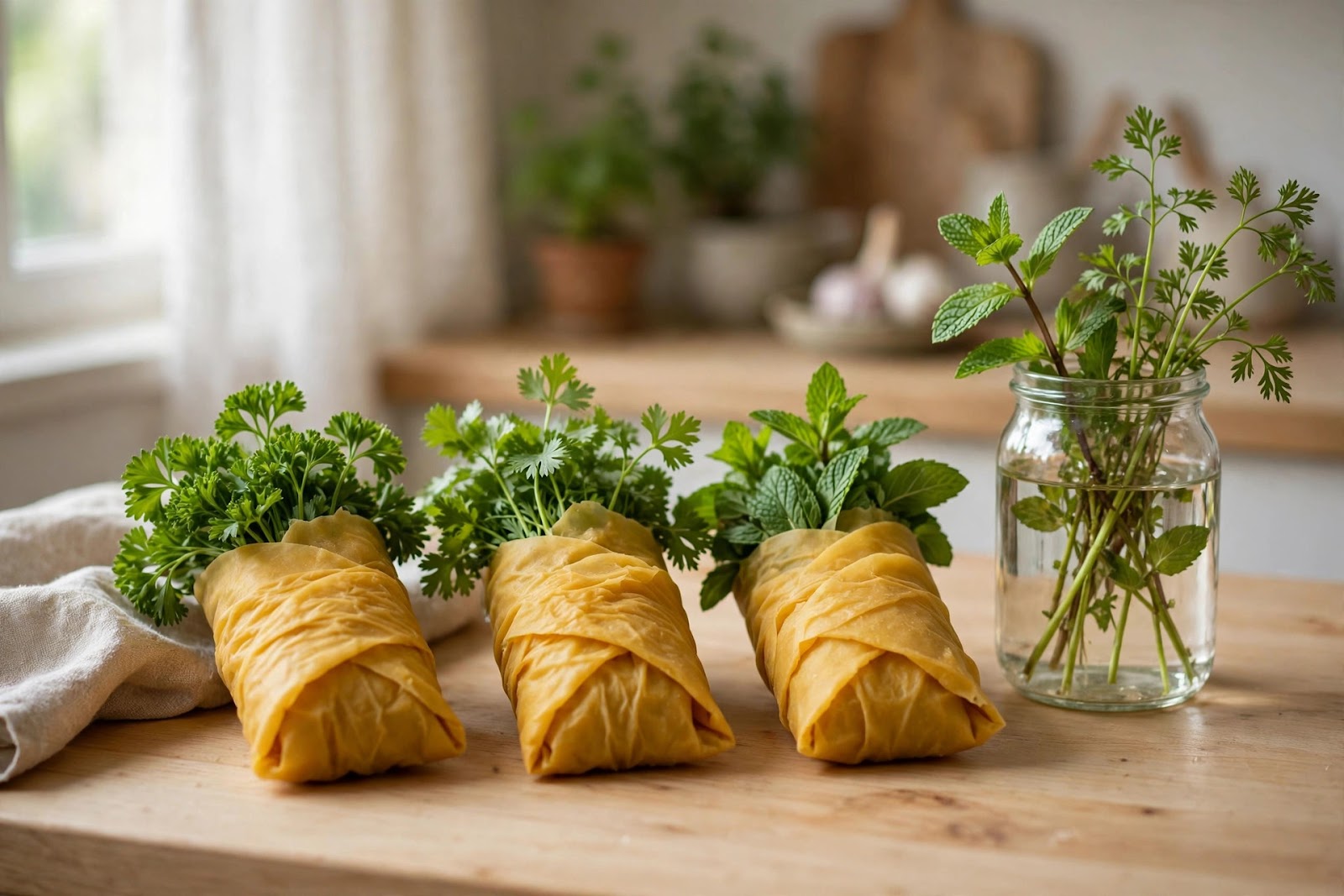
My plan was simple. One week, four herbs, four different storage methods. Parsley in a beeswax wrap. Coriander in a jar of water with a wrap over the top. Mint in a damp tea towel inside a wrap. And basil — my control group — left loose in the crisper drawer, the way I'd always done it, so I could compare honestly.
The first wrap nearly put me off entirely
Here's the thing nobody tells you about beeswax wraps: they're stiff when cold. The first time I tried to fold one around a bunch of parsley, it crackled like paper and sprang open the moment I let go. I stood there holding a half-wrapped bunch of parsley, feeling like I'd been sold a very expensive piece of cardboard.
The trick, which I worked out on the third attempt, is the warmth of your hands. Hold the wrap around the herbs for ten seconds and the wax softens just enough to seal. Press the edges together like you're sealing an envelope. Once it sticks, it stays.
That first evening, I felt a bit ridiculous. I'd spent eleven pounds and ten minutes wrapping herbs like presents. My partner walked in, looked at the fridge, and asked why the parsley was wearing a coat. Fair question.
Day three: the surprise
By day three, the difference was already obvious. The loose basil in the crisper had started to darken at the edges, exactly as it always does. The wrapped parsley looked almost exactly the same as the day I bought it. Bright green, perky, smelling like parsley when I unwrapped it.
The coriander in the jar of water was the real surprise. I'd trimmed the stems, stood the bunch upright in a jam jar with about an inch of water, then draped a wrap over the top like a little tent. It looked like a tiny herb greenhouse. On day three it was still standing upright, leaves open, not a hint of slime.
I'll be honest: I checked on them more often than I needed to. I kept opening the fridge just to look. There's something oddly satisfying about unwrapping a bundle of herbs that still looks alive after three days when you're used to finding a wet green mess.
Day five: the mint goes wrong
The mint was my failure. I'd read somewhere that a damp tea towel inside a wrap was the gold standard for mint, so I wrapped a wet tea towel around the stems and sealed the whole thing up tight. By day five, the mint smelled musty and the stems had gone brown and soft.
The problem was obvious once I thought about it. Too much moisture, sealed in too tight, with no air at all. Mint is already a damp-loving plant; wrapping it wet in wax was like putting it in a sauna and locking the door. The wrap didn't fail — I did.
I salvaged what I could, dried the remaining leaves on a clean tea towel, and made a pot of mint tea that evening. Not a total loss. But it taught me the most useful lesson of the week: beeswax wraps breathe a little, but they don't forgive you for trapping a puddle inside them.
What the wraps are actually made of
Before I bought them, I assumed a beeswax wrap was just cloth dipped in wax. It's a bit more than that. The ones I bought are cotton infused with beeswax, tree resin, and a little jojoba oil. The wax makes them waterproof, the resin makes them sticky enough to seal, and the oil keeps them flexible. Or at least that's what the label said, and the label has held up so far.
There are vegan versions made with plant waxes instead of beeswax, usually candelilla or soy wax. I've not tried those, so I won't pretend I can compare them. If you keep bees out of your kitchen for ethical reasons, they're worth a look — but check whether they're actually sticky enough to seal, because a wrap that won't seal is just a fancy tea towel.
One thing worth knowing: wraps smell faintly of honey for the first week or so. Not strongly, and not on the food — I never once tasted honey in my parsley — but if you put your nose right up to a fresh wrap, there's a warm, waxy smell. It fades. Mine stopped smelling of anything much by week three.
They also stain. The turmeric incident is worth mentioning, because someone will do it. I wrapped half an onion that had been sitting next to a turmeric-stained chopping board, and the wrap picked up a yellow tinge that never fully washed out. It still works fine. It just looks like it's been around. Which, to be fair, it has.
The other things I started wrapping
Once the herb experiment worked, I started testing the wraps on everything else in the fridge, because that's what you do when a £11 purchase actually delivers. Half a lemon: wrapped, still juicy four days later, no dried-out cut face. A wedge of cheddar: wrapped, no sweaty plastic smell, and the cheese didn't dry out at the edges the way it does in cling film.
Bread was the surprise failure. I tried wrapping half a loaf in the large wrap, hoping it would stay soft. It didn't. The crust went soft and the crumb went stale at the same time, which is the worst of both worlds. A cotton bread bag does that job better, and I went back to it after two days. Wraps are good at a lot of things. Bread isn't one of them.
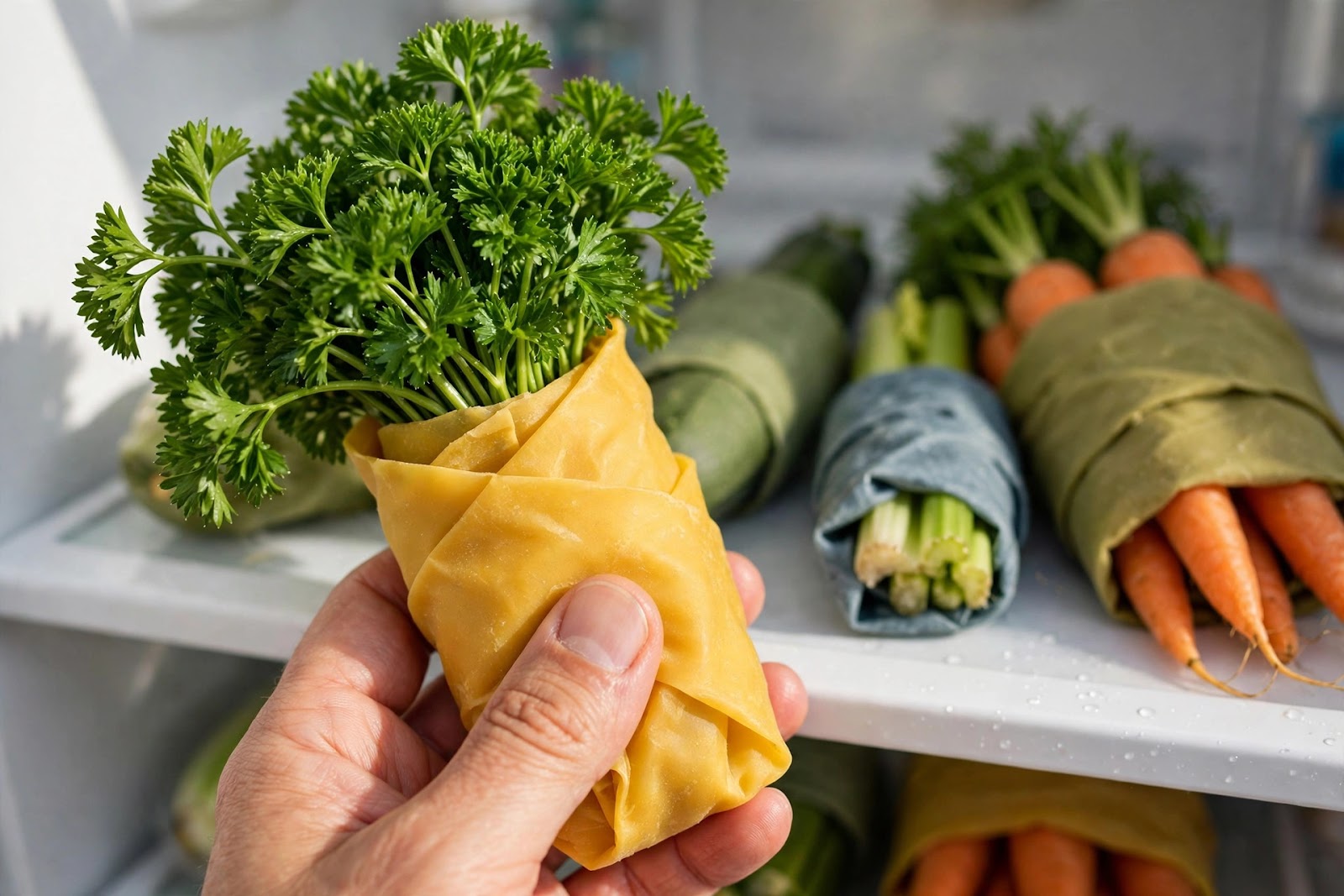
The other win was covering bowls. Leftover rice, half a chopped onion, a bowl of cut cucumber — the large wrap seals over a bowl with a press of warm hands, and it holds. No more juggling three sizes of cling film and a roll that tears sideways. My cling film roll is still in the drawer, by the way. I haven't thrown it away. There's a time and a place for it — wrapping a dish for the freezer, for one — but I reach for it about once a fortnight now instead of daily.
Day seven: the verdict
Seven days in, here's where things stood. The parsley, wrapped dry in a single beeswax wrap, was still good enough to chop into a salad. Slightly softer than fresh, but green and fragrant, with no slime at all. I'd call that a win.
The coriander in the water jar with a wrap tent was the star of the show. Still upright, still bright, still smelling like coriander. I used the last of it on day eight in a curry, and it tasted like it had been bought that morning. That method alone was worth the price of the wraps.
The basil, my control group, was a write-off by day four, exactly as usual. Dark spots, limp leaves, that sour smell. The drawer method had never worked, and now I had the comparison to prove it instead of just a vague feeling.
And the mint? Gone. Compost. A lesson learned, not a herb saved.
What I do now (and what I'd skip)
Seven weeks on, the wraps are part of my routine, and I've settled into a system that actually works. Parsley and coriander get the jar-of-water treatment with a wrap over the top — that one method covers the two herbs I buy most. Anything leafy and dry gets wrapped directly, no damp cloth, no fuss.
I wash the wraps in cool water with a drop of washing-up liquid, then hang them over the dish rack to dry. Hot water is the enemy; it melts the wax coating and ruins them. I learned that the hard way too, when I rinsed one under a hot tap in week two and it came out with a bald patch. It still works, but it looks a bit tragic.
One wrap has lasted me the full seven weeks so far with no sign of giving up. If it makes it to six months, the £11 pack will have paid for itself many times over in herbs I didn't throw away. The maths is rough, but I was binning about £1.50 of herbs a week. That's nearly £40 over six months. Even if I replace the wraps every year, I'm still well ahead.
There's also a small satisfaction in opening the fridge and seeing wrapped bundles instead of a graveyard of plastic bags. It's a tiny thing, and I know it sounds precious, but the fridge genuinely looks tidier. My partner noticed too — he said the fridge looks like someone who has their life together lives here now. I'll take that.
Would I buy them again? Yes, but I'd skip the small size. The small wrap is too fiddly for a bunch of herbs and too small for a bowl, so it mostly sits in the drawer. Buy two mediums and a large, and you're covered for herbs, half a lemon, and a sandwich.
The honest truth is that beeswax wraps didn't change my life. They just fixed one small, annoying problem — the Friday parsley that died by Thursday. And sometimes that's exactly what a good swap is supposed to do. Not a revolution. Just a drawer that doesn't smell of rotting herbs anymore, and a curry on day eight that tastes like it was made with fresh coriander.


